Monday, 28 March 2016

Allan Gardens on Easter Monday

When today dawned grey and with drizzle threatening there seemed a need for a cheerful and colourful antidote.
Looking west across the Don Valley to St. Jametown

I decided to take Scylla and walk over to Allan Gardens, Toronto's historic cast iron and glass domed Conservatory, the Palm House section built in 1910. The original 5 acre parcel of land was donated to the city by George Allan in 1858. A structure was erected and in 1864 the city, on the condition that the grounds were accessible to the public and admission was free, turned over the park to the Horticultural Society. In 1888 the park and its buildings were returned to the city. Today Allan Gardens remains one of the gems of the city, designated under the Ontario Heritage Act and open to the public, free of charge, 365 days a year!

The grounds surrounding the Conservatory look sad and inert at this time of year. The treasures are all under glass;  there are five different climatic zones, each with its own temperature and humidity. 
Allan Gardens with its central Palm House

The Palm House greets visitors with its still life of a floral jazz musician seated at the upright piano playing under a tree festooned with Easter eggs. There are hydrangeas everywhere, blue and pink, some with variegated foliage.
The pianist seated at the upright piano
Coloured Easter eggs dangling above the keyboard
Pink hydrangea with variegated foliage
And the blue version

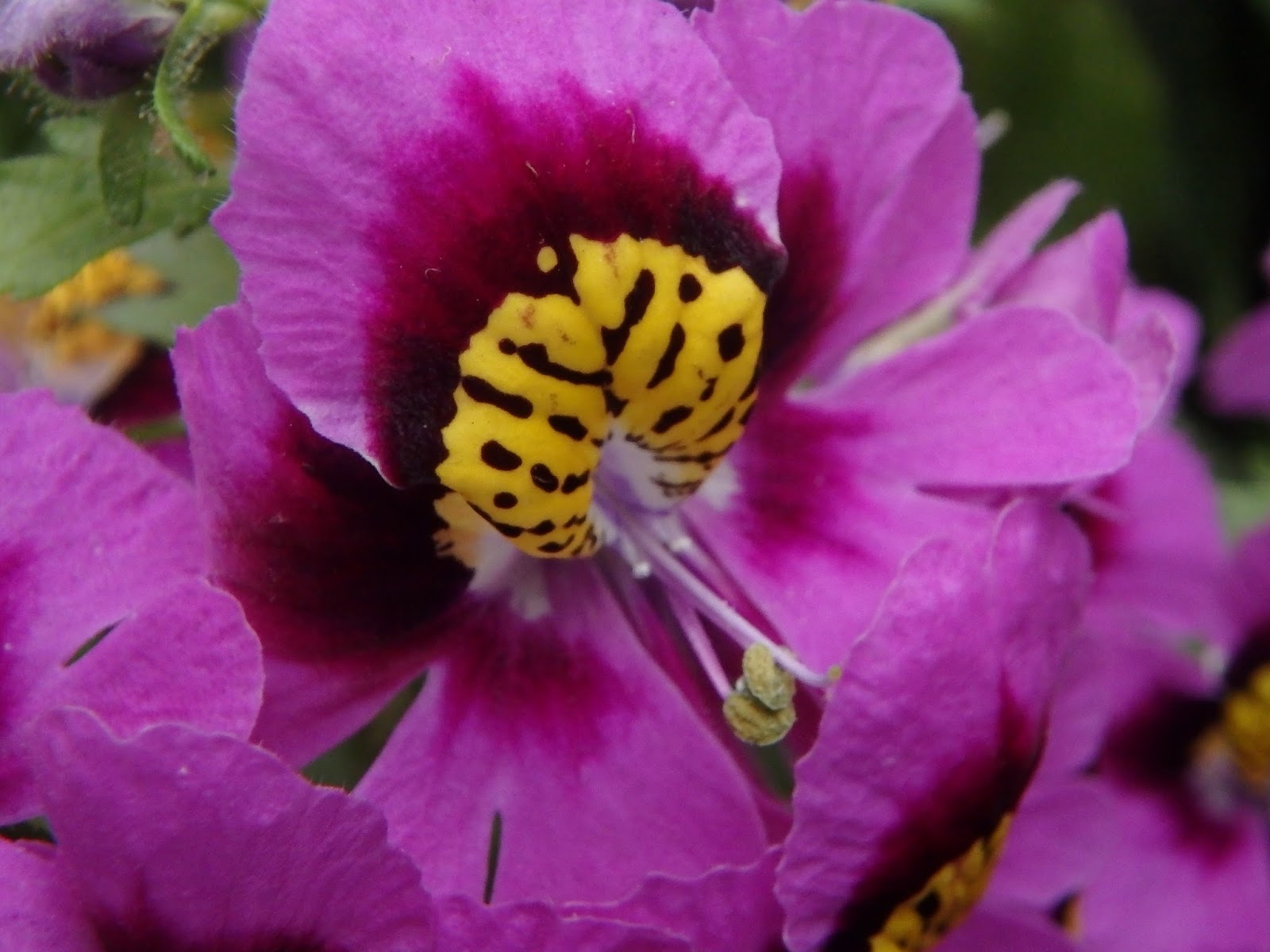
The room to the left has lots of forced bulbs, schizanthus in various hues from cream to fuchsia and visiting Easter bunnies. Schizanthus is sometimes referred to as the poor man's orchid.
An antique iron urn filled with schizanthus and variegated ivy

Schizanthus close-up

Agapanthus, one of the true blue flowers
A pair of Easter bunnies

But for me today, the highlight is the bromeliad room. There are turtles in a little pond under a water wheel and orchids, still in their own pots, but submerged into the soil. But mainly it is the wonderfully varied bromeliads.

Bromeliads are a huge family, numbering up to 3000 named species and 56 genera. The poster bromeliad is the pineapple. But Spanish Moss (which is neither Spanish nor a moss) is also part of this vast family.
Spanish Moss
A close-up of a Spanish Moss flower 

Bromeliads can be terrestrial which means they grow in the ground. Habitat can include bright and sunny sandy beaches all the way through to the shaded humusy understory of a forest. Saxicolous species grow on rocks and epiphytes thrive on other plants or even non-organic supports like telephone poles and wires. Epiphytes have the ability to take moisture and nutrition from the atmosphere and so are sometimes referred to as "air plants".
A bromeliad "ball" in full bloom

Bromeliads have in common a spiral arrangement of leaves, in a single plane, called a rosette. The bases of the leaves may form a water reservoir, or catch basin, for moisture and nutrition like leaf litter. Terrestrial bromeliads which are lacking this water reservoir rely on their roots for water and nutrient absorption. The roots of epiphytic bromeliads harden off and are used to fasten the plant to its host. People sometimes refer to epiphytes as parasitic plants but this is an unjust allegation. Epiphytes do not steal from their host, merely use it as a support.  

There was a wall display of bromeliads all with their red flower stalks at exactly the same height. I asked one of the staff gardeners how they managed such amazing synchronicity. She replied, "We bought them." A welcome reminder that even the professionals take short cuts. 
The hanging display of beautifully coordinated bromeliads in bloom

By the time I left the skies had opened up and I wished Scylla and I could take a short cut home!
View looking east to Riverdale from Cabbagetown


Sunday, 14 February 2016

How do birds survive in extreme cold?

This morning at 5AM our thermometer registered -32C, even colder than the predicted low of -28. According to the Farmzone website yesterday's low for Madoc was -38! Who knows if we're in a "balmy" part of the borough or if the temperature had risen from an overnight low of -38 to -32 predawn. Bottom line - it was cold!

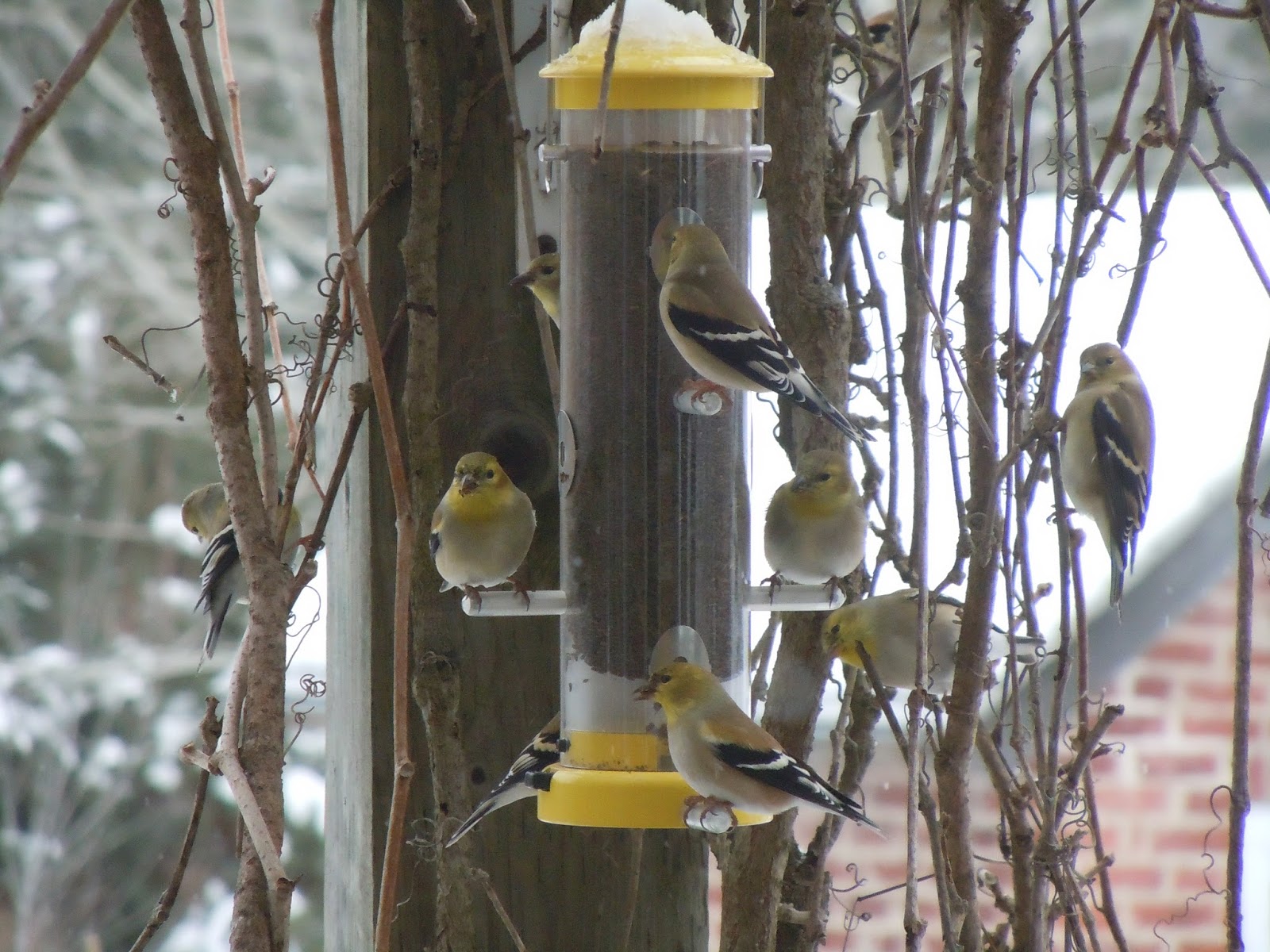
We arrived here Saturday around noon. Once we had unpacked and gotten the home fires burning Christopher went out to fill the bird feeders. Within minutes there were chickadees at the platform feeder. They are always the boldest and therefore the first. But shortly after they were joined by sparrows, finches and house finches and later blue jays.  It always takes a little longer for the juvenile finches to gather at the nyjer seed feeder Alex gave us for Christmas a few years ago.
Juvenile finches at the nyjer feeder. At this age both sexes are an olive green.
And other juvenile finches feeding on the spillover from the feeder above
I had gotten new skis and boots and, notwithstanding the temperature of -24C,  I was bound and determined to try them out. I was out for two and a half hours and got frost bite on my left ear lobe. That made me curious how those little birds could survive 24/7 in such brutal temperatures and arctic winds.
Trying the new gear in front of the bird feeder
Well it seems not all of them do. For some breeds about 75% of mature birds survive the winter vs 40% of the younger ones. Older birds are dominant socially and younger birds keep their distance from their belligerent elders. The safest and therefore preferred place to eat is the top of the trees - safest from  predators. The older birds get first dibs on this spot and the younger birds are forced to settle into the lower branches.

Simply put birds congregate in groups, eat - fatty foods if possible, fluff up their feathers at rest and hope for a cosy small cavity in which to overnight.

Notwithstanding selfish seniors, it is still true that birds of a feather really do flock together.
Generally there is safety in numbers - more eyes to be on the lookout for predators and better chances of finding the richest food sources. For wild birds eating at feeders the fattiest foods are best; black sunflower seeds, suet, peanuts. Even though squirrels are not predators birds give them a wide berth. When a red squirrel parks itself at our feeder some birds keep a vigilant eye from the safety of a nearby tree while others take the chance and eat the spilled seed on the ground below the feeder.
The red squirrel eyes the feeder from a nearby willow
Once the squirrel is nestled into the feeder the bolder birds gather below to eat spilled seed

Spots of yellow indicate an oriole and finch eyeing the feeder wistfully 
Like us, a big meal slows birds down making them more vulnerable to predators. If they've gotten their fill they take a rest and puff up their down feathers which help trap warm air in air pockets next to their bodies. Despite their misleading name, Downy (and all) woodpeckers don't have down feathers.
Finches at rest all puffed up while they "feather fluff"

Downy woodpecker at the suet feeder
Birds are also extremely susceptible to small changes in wind so they tend to congregate on the side of the tree away from the wind. If that side is also in the sun so much the better.
A blue jay preparing for a landing
Blue Jays also sample the suet while an oriole looks on

And finally, a roosting cavity just slightly larger than themselves helps the bird warm the surrounding air overnight. Other birds crowd together in a roosting cavity to share body heat. And others still can enter into a torpor-like state by lowering their metabolism to conserve energy and require less heat.

From year to year we have some loyal visitors like the mourning doves, chickadees and juncoes. Other birds are more discriminating I guess - trying us out but never to return for a second visit. This is the case with orioles - stunning citrus yellow birds bigger and brighter than the yellow and olive juvenile finches.
Orioles gather to eat seeds on the ground on Jan. 1, 2013
Birds also benefit from seed heads on perennials and homemade goodies like peanut butter pine cones. While this winter hasn't had the sustained cold and heavy snow of the last two years this weekend's deep freeze is only beaten by the record low set in 1899. Whatever the weather, birds can use all the help we can give them. And in return they reward us with colour and industrious activity in what can seem otherwise a monotone and lifeless winter landscape.


Sunday, 7 February 2016

Frank Meyer and the Meyer Lemon

A seasonal treat, but not local for us in Toronto, is the Meyer Lemon. They hailed from China originally and are thought to be a cross between Mandarin oranges and lemons. Meyer lemons are smaller and more round than regular lemons. Their flesh often has a "peachy" tint and is less acidic than the common Lisbon or Eureka lemon with a skin that is thinner.
Meyer Lemons
Discovered in 1908 by Frank Meyer, an agricultural explorer, they bear his name. Like John Muir, founder of the Sierra Club, he preferred work in the field to life at a desk. But unlike John Muir his name is virtually unknown today. Yet examples of his legacy are found in virtually every garden in North America today.

Frank Meyer was the first agricultural explorer charged with searching for economically useful, rather than ornamental, plants. He was employed by the Foreign Plant Introduction program of the USDA and sent to China initially. Later travels took him to Korea and Siberia. Over four expeditions to Asia he discovered and sent back cuttings, seeds and clippings of hundred of plants that have changed the botanical landscape of North America. His discoveries include grasses that are now used for lawns, scions and rootstock for fruit tree breeding, soybean and alfalfa and innumerable other ornamental and agricultural plants.

He was an indefatigable explorer walking through mountain ranges, across deserts and wading through icy streams in climatic extremes ranging from snowstorms to tropical heat and humidity. He was assaulted by robbers and thieves, bedbugs and scorpions, and often walked 25 to 40 miles a day. On his third expedition on one single day, November 9, 1914, he and his party crossed four mountain passes at elevations above 11.000 feet. On another expedition from Korea to Siberia he and his group lived on nothing but boiled oats for the last two weeks. He camped in tents when it was so cold the tea froze in the cup before it could be drunk. His return to the US from England was on the Mauretania in March 1912, following one day behind the ill-fated Titanic. His death is a mystery. On June 1, 1918 he boarded a steamer bound for Shanghai. Later that evening he could not be found. His body was eventually recovered from the Yangtze River. It was never determined whether his death was a suicide or the result of foul play.
Frank Meyer and his collecting party at 4.000 feet near Yin Tau Ko, China

A biography of Frank Meyer was written by Isabel Shipley Cunningham, Plant Hunter in Asia. There is an excellent article by her with photographs at http://arnoldia.arboretum.harvard.edu/pdf/articles/1984-44-3-frank-meyer-agricultural-explorer.pdf

One of the best uses for Meyer lemons is Meyer Lemon Marmalade. There are many ways to make marmalade; preparation can take two days or just a couple of hours, texture can be thick cut or fine. I prefer the method which involves pre-soaking cut rind overnight and results in a somewhat robust texture.

The first step is to halve the lemons and remove and save the seeds which are a big source of pectin, necessarily for gelling but allowing the marmalade to be made without the use of commercial gelatine.

Halved lemon reveals seeds  to be removed
The seeds, high in pectin, are set aside

After the seeds are removed each half is cut into quarters and then those quarters are sliced thinly.
Meyer lemons waiting to be cut, the lemons sliced and put into a non-reactive pot
The sliced lemons, any juice accumulated, water and the seeds, gathered into a cheesecloth bag, are put into a non-reactive bowl, covered and left to stand overnight.
The seeds are gathered into a cheesecloth bag

Sliced, lemons, seeds and water rest overnight on the counter

The next day the mixture is brought to a boil over medium heat. I add the sugar at that point and then it is kept on a medium boil/simmer until the gelling point is reached. Once the gelling point is reached the bubbles become small and cover the entire surface. I also test by putting half a spoonful on a plate in the freezer for a couple minutes. When it is removed from the freezer the marmalade has gelled if the cold sample wrinkles when pushed with a finger. When sure the gelling point has been reached the bag of seeds is removed and the marmalade can be ladled into sterilized mason jars.

I like to process the marmalade in a hot water bath. This is not necessary because of the high sugar content but I like to take this step because I can find out in five minutes, rather than five hours, whether the jars have sealed.
Canned and processed Meyer Lemon Marmalade 
Once cooled the marmalade can be stored for a year for a little taste of sunshine all year long.

I have a somewhat pathetic Meyer Lemon plant which is fun but only bears one or two little fruits a year.
The finished product in front of the raw material!


Sunday, 31 January 2016

Year of the Pulse

There has been a lot of talk about this being the UN's Year of Pulses. I first learned that in November when I heard Vandana Shiva speak in Toronto. It is fantastic that there has been so much buzz about pulses. And it is only February. It seems a bit of a shame that last year's honouree, Year of Soils, seemed to pass without much discussion. Soil, like air and water, is necessary for all life on earth. And our soils are under great pressure agriculturally.

But back to the celebration of pulses. They are members of the legume family and, as such, fix nitrogen in the soil. This is their great contribution to the health of soil in a sustainable agriculture model making them an essential component of crop rotation.

Pulses are the dried seed of a pod and include dried beans, dried peas, lentils and chickpeas. Canada has a big role to play as one of the world's biggest producers of pulses and the largest exporter of lentils.  The largest market for our lentils and peas is India, also one of the biggest producers of pulses. Other heavy hitting producers are Pakistan, the US, Australia and Myanmar, formerly known as Burma.
Various lentils including the French delicacy, De Puy lentils
 
Heirloom beans I grow including Blue Jay, Orca, Jacob's Cattle, Carmina  and  Vermont Cranberry
And more heirloom beans; Black Valentine, Cannellini and another I've lost track of which I call Brown Mottled.

In addition to their important role as nitrogen fixers in the soil, pulses are a powerhouse of nutrients. At a time when feeding the world's exploding population is an ongoing concern, they have an important contribution to make. Pulses are high in protein and fibre, low in fat and also contain zinc, iron and phosphorus with traces of folate and B vitamins. As food from plants they also contain phytochemicals. Phytochemicals are not essential for sustaining human life but the same properties that help protect the plant are thought to also protect us against some diseases. Pulses are also complex carbohydrates which are beneficial for slow absorption of nutrients and therefore good for slow release energy and low on the glycemic index.

Being such a food powerhouse, it is not surprising that pulses have been cultivated for millennia and that virtually every cuisine has at least a couple signature dishes made from pulses. When cooking pulses they all come dried and in some cases, also canned. If you have the time, dried versions are preferable to canned which will have added sodium. When reconstituting dried beans it is important not to add salt until the beans have completely absorbed the water and plumped up.

Some of these dishes include, from the Middle East and made using chickpeas
Hummus
Falafel
Baked beans are a classic from North America. The process of reconstituting dried beans includes low and slow cooking with water and often dried or dijon mustard and often maple syrup - a real pioneer dish.
Slow baked beans
From the British Isles comes split pea soup or pease porridge. Dried peas need less time to absorb the liquid and naturally become mushy. You can puree the soup or not according to the consistency you prefer.
Split pea soup
Italian minestrone soup contains beans and is never pureed.
Minestrone soup
India's many versions of Daal is made from lentils. Each region has its own characteristic spices.  Like split peas lentils tend to absorb liquid and reconstitute quickly, also breaking up on their own.
Daal


Saturday, 2 January 2016

Off piste with Scylla

It is always an adventure cross country skiing from the back door of the farmhouse. With the first snow of the season there is just enough of the white stuff to cover most of the grass but not deep enough to make me sink to my knees with each step (no gliding in that much snow...) as I break through virgin snow.

I love skiing from the house. It is such a treat not to have to get in the car and so nice to have the companionship of Scylla, our Australian shepherd. But it is probably not everyone's cup of tea.

For bona fide skiers conditions are probably less than ideal. First of all there is the need to break a trail. And then there are the fences to be crossed between the fields which lie between our house and the entrance to the woods.
The split cedar rail fence at the end of our field.
The next fence has the added challenge of two heights of barbed wire in addition to the spit cedar rails which have mostly collapsed
Entering the woods is easy for Scylla but I have to do the limbo to get underneath the wire fence.

Once in the woods there are further obstacles, all of which need to be circumvented; branches and other trash on the path, the occasional fallen tree, pools which have not yet frozen in low-lying spots and barely exposed stones which would be quite unfortunate to hit on a nice downward slope when one was enjoying a bit of well-earned speed (having herringboned up the hill to get to the top).
A fallen tree lying across the trail
Protruding branches and barely covered rocks
Here we need to make a big detour to avoid the open water in the lowest part of the trail
A rock not quite covered by snow

In the woods it is clear that the snow may be new for us but many have gone before - there are tracks of deer, rabbits, small rodents to name a few.
I love the way the animals, especially the larger ones like deer often prefer the trail to forging a path through the woods
Deer footprint
Here our paths diverge - I to the left, the deer to the right
I will never be a skilled and elegant skier, skimming along the snow with style and grace. The challenges of this trail with its daunting steep hills are much more suited to my rough and ready "never say die" enthusiasm.
It is difficult to capture but this hill is short and steep followed by an equally daunting ascent . At least there's no open water at the bottom...

All those tracks make a ski much more stimulating for Scylla than a walk along the road or through the park in the city. But she is also all about playing the angles. As we head out she will never go first - no breaking trail for her. Whenever I stop to turn around and see if she is following she freezes and stalwartly also looks behind - another scout on the lookout for any danger sneaking up from behind.
Having decided to go back Scylla is happy to lead the way

Once we are ready to turn around and head back she is very happy to take the lead. The snow is easier for her to navigate now that it is nicely packed under my ski trail.

The fences provide a challenge for Scylla too. But of a different nature. Instead of scrambling over them she needs to find an opening to squeeze her considerable girth through.
Scylla squeezes through a gap in the fence

Now that we're back in the warmth of the house, having eaten lunch, it is time for a well-deserved lie-down on the red couch.
At home at last