Saturday, 2 April 2016

April Fool's comes one day late

Today dawned grey and drizzling but that soon became an April blizzard.
Looking east at about 8 this morning. Crows in the trees.

The last time Avo and I had been cross country skiing we had come across a trail I hadn't seen before. Ever since I had wanted to explore it. So inclement weather or not, today was the day. Expecting that spring run-off would make access through the woods near our house impossible, I decided to drive and park just north of where I knew we could catch the new trail.
The swollen marsh across the road from the woods

The first stumbling block was deep water on the trail where it joined the road. But Scylla and I walked along the road until we could scramble through the woods to hook up with the trail.
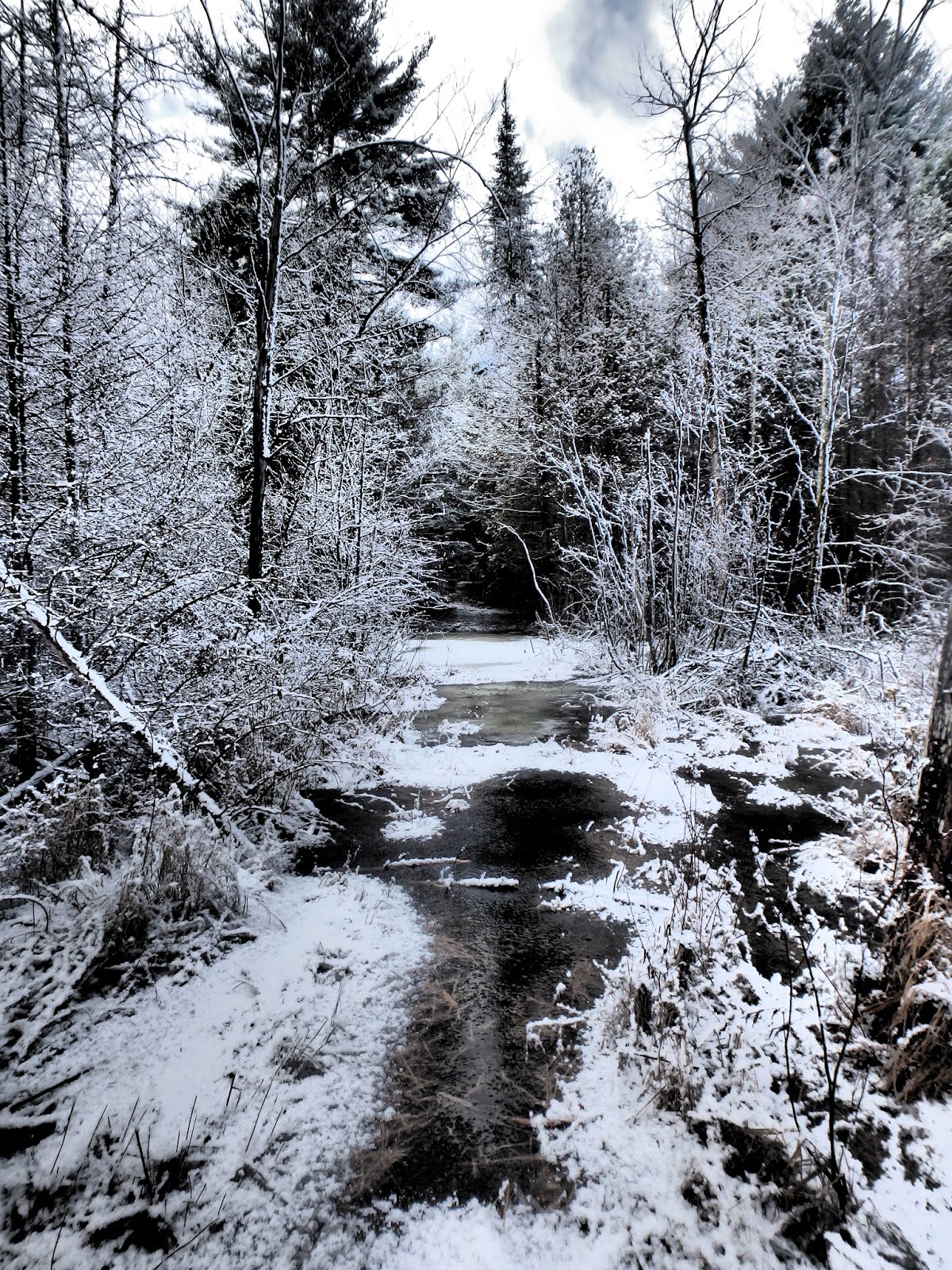
The trail is tantalizingly clear. Just not navigable..

It became beautiful after awhile; sunny, with the sound of grouse in the background and melting snow falling from above. While this trail is new to me and exploring it felt like an adventure, it really is impossible to escape to genuine wilderness. This woods is somewhat managed - there are trails cut through the forest and a certain amount of logging throughout the woods. But there are venerable old stumps and snags left to rot on the ground. Both provide welcome homes for inhabitants of the forest.
A stump with cavities carved out
A birch stump with vertical housing
This stump has much larger cavities

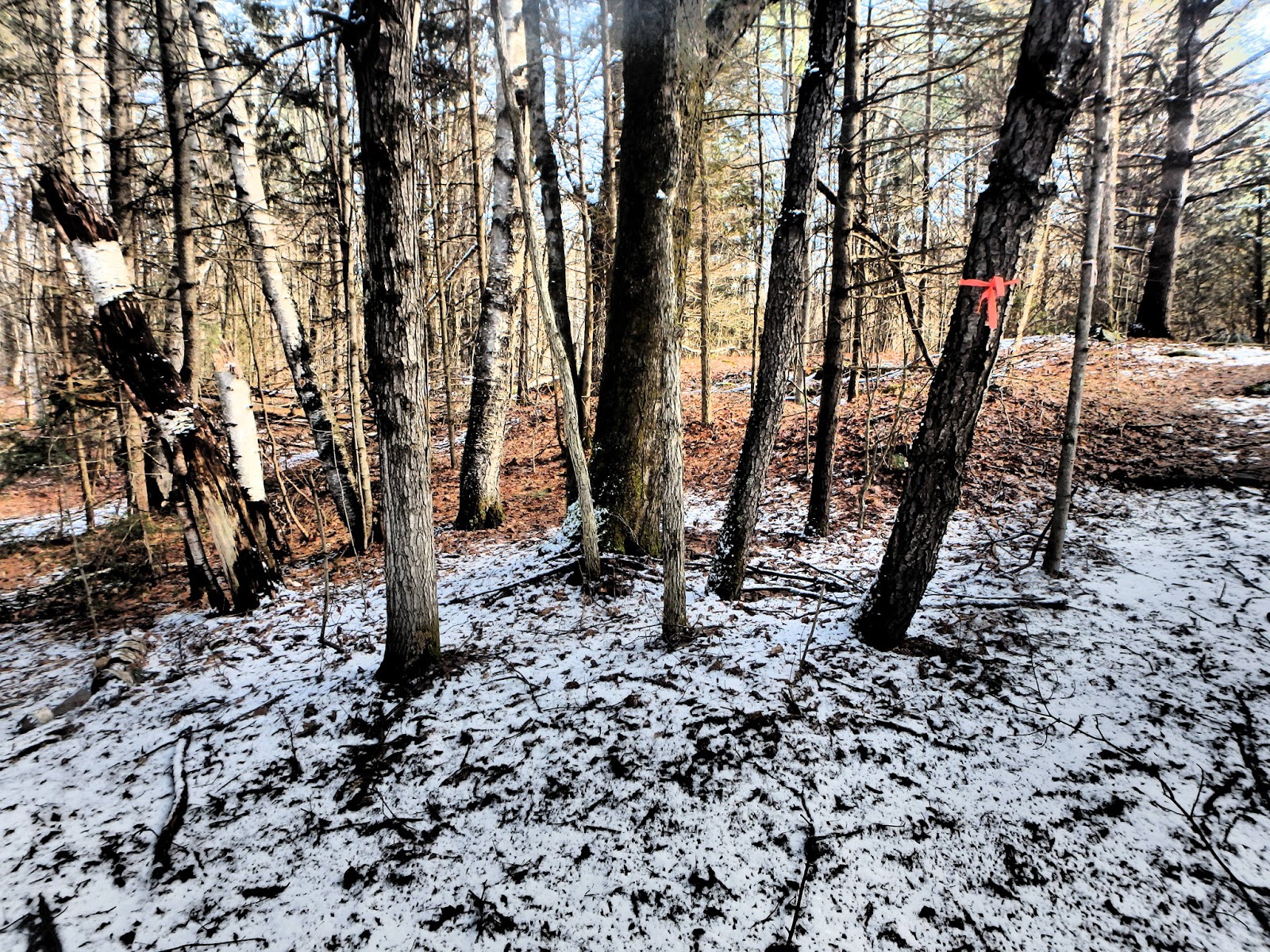
Occasionally when the trail turns 90 degrees surveyor's tape marks the change of direction.
Surveyor's tape marking a change in the trail direction 

And sometimes the signs of human activity are a little less benign (at least to me, essentially an urbanite).
Target practice?


These look like bullet holes


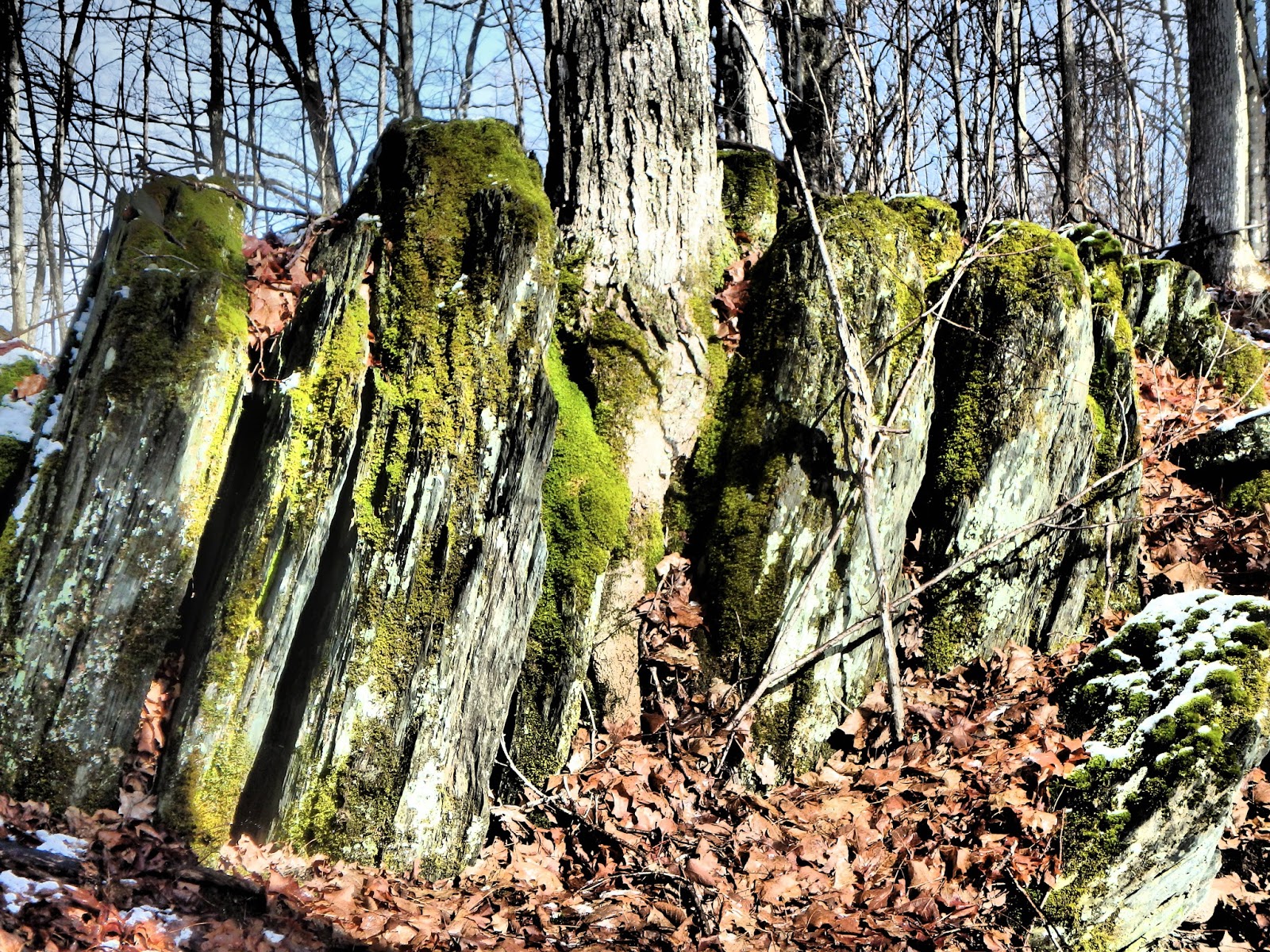
The rock outcroppings are beautiful and often dramatic.
Beautiful lichen on the side of the rock

Trees growing between the rocks
A lovely terraced rock outcropping
And some striking vertical rocks

While it may not be the Bleasdell Boulder, Scylla is suitably intrigued by this erratic. Erratics are rocks carried by glacial ice flow. Because they can have travelled hundreds of kilometres they are often different kind of rock from what is native to where they are sitting.
Scylla is captivated by this erratic

Scylla and I scrambled up a beautiful rock outcropping to an open sheltered area above. The sun shone and there was no wind. The perfect place to rest and soak up some rays. When we reached the top I saw that someone else had had the same idea. So while I rested on the lawn chair Scylla surveyed the domain.
Convenient seating 
Time to soak up some rays
Scylla keeps a watchful eye

Our walk was punctuated by overflowing creeks in many places.
A swollen creek floods out the trail
All these creeks are part of the Moira River watershed
The fast flowing water, especially over rocks and logs, is highly oxygenated
The marshy areas are temporary ponds, sometimes aided by beaver activity.

And farmers' fields also have vernal ponds in low lying areas.
Farmer's field with temporary pond
Back at home, our own Railway Creek is swollen and flowing quickly.
Railway Creek, another tributary of the Moira river

Monday, 28 March 2016

Allan Gardens on Easter Monday

When today dawned grey and with drizzle threatening there seemed a need for a cheerful and colourful antidote.
Looking west across the Don Valley to St. Jametown

I decided to take Scylla and walk over to Allan Gardens, Toronto's historic cast iron and glass domed Conservatory, the Palm House section built in 1910. The original 5 acre parcel of land was donated to the city by George Allan in 1858. A structure was erected and in 1864 the city, on the condition that the grounds were accessible to the public and admission was free, turned over the park to the Horticultural Society. In 1888 the park and its buildings were returned to the city. Today Allan Gardens remains one of the gems of the city, designated under the Ontario Heritage Act and open to the public, free of charge, 365 days a year!

The grounds surrounding the Conservatory look sad and inert at this time of year. The treasures are all under glass;  there are five different climatic zones, each with its own temperature and humidity. 
Allan Gardens with its central Palm House

The Palm House greets visitors with its still life of a floral jazz musician seated at the upright piano playing under a tree festooned with Easter eggs. There are hydrangeas everywhere, blue and pink, some with variegated foliage.
The pianist seated at the upright piano
Coloured Easter eggs dangling above the keyboard
Pink hydrangea with variegated foliage
And the blue version

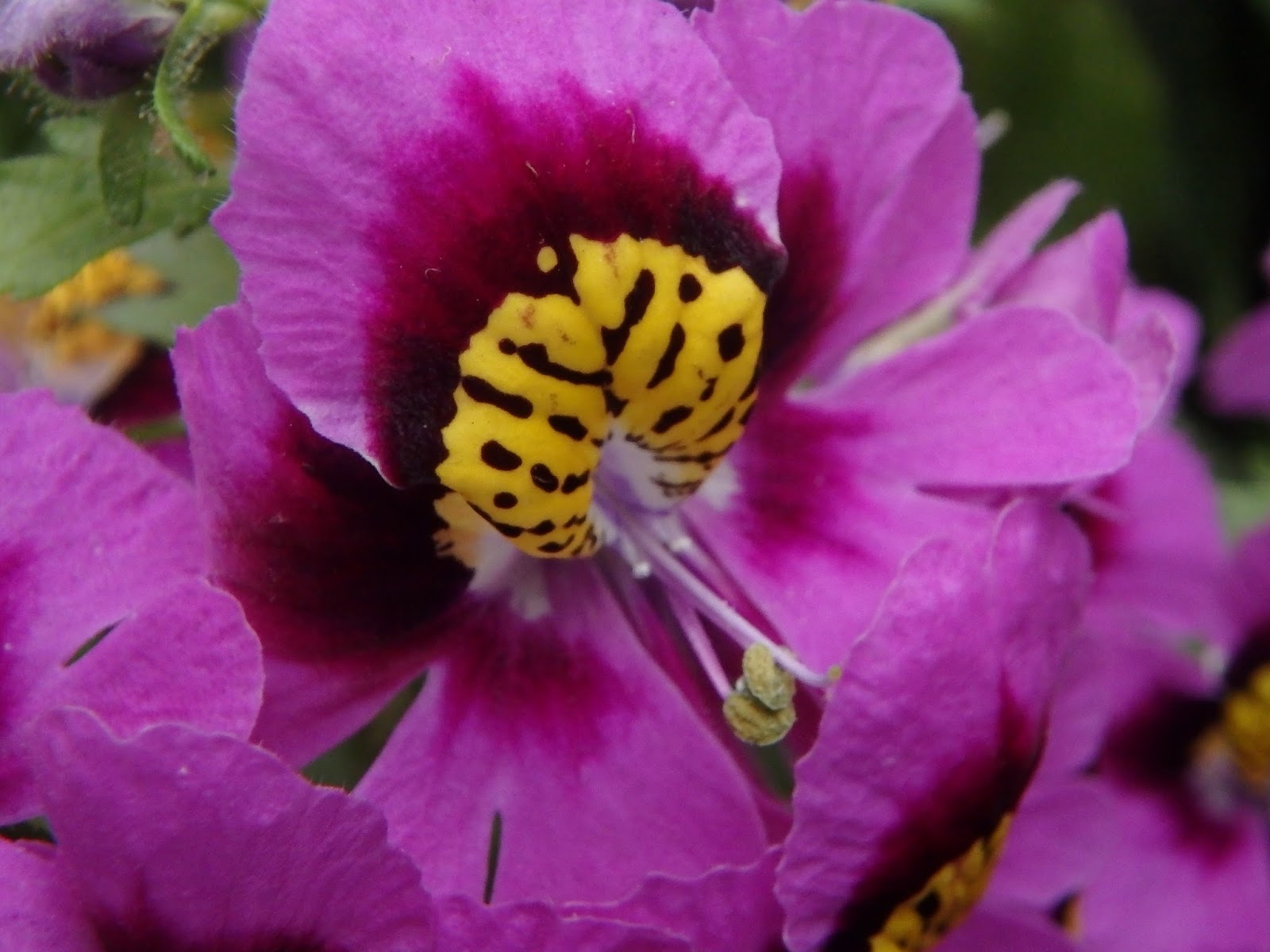
The room to the left has lots of forced bulbs, schizanthus in various hues from cream to fuchsia and visiting Easter bunnies. Schizanthus is sometimes referred to as the poor man's orchid.
An antique iron urn filled with schizanthus and variegated ivy

Schizanthus close-up

Agapanthus, one of the true blue flowers
A pair of Easter bunnies

But for me today, the highlight is the bromeliad room. There are turtles in a little pond under a water wheel and orchids, still in their own pots, but submerged into the soil. But mainly it is the wonderfully varied bromeliads.

Bromeliads are a huge family, numbering up to 3000 named species and 56 genera. The poster bromeliad is the pineapple. But Spanish Moss (which is neither Spanish nor a moss) is also part of this vast family.
Spanish Moss
A close-up of a Spanish Moss flower 

Bromeliads can be terrestrial which means they grow in the ground. Habitat can include bright and sunny sandy beaches all the way through to the shaded humusy understory of a forest. Saxicolous species grow on rocks and epiphytes thrive on other plants or even non-organic supports like telephone poles and wires. Epiphytes have the ability to take moisture and nutrition from the atmosphere and so are sometimes referred to as "air plants".
A bromeliad "ball" in full bloom

Bromeliads have in common a spiral arrangement of leaves, in a single plane, called a rosette. The bases of the leaves may form a water reservoir, or catch basin, for moisture and nutrition like leaf litter. Terrestrial bromeliads which are lacking this water reservoir rely on their roots for water and nutrient absorption. The roots of epiphytic bromeliads harden off and are used to fasten the plant to its host. People sometimes refer to epiphytes as parasitic plants but this is an unjust allegation. Epiphytes do not steal from their host, merely use it as a support.  

There was a wall display of bromeliads all with their red flower stalks at exactly the same height. I asked one of the staff gardeners how they managed such amazing synchronicity. She replied, "We bought them." A welcome reminder that even the professionals take short cuts. 
The hanging display of beautifully coordinated bromeliads in bloom

By the time I left the skies had opened up and I wished Scylla and I could take a short cut home!
View looking east to Riverdale from Cabbagetown


Sunday, 14 February 2016

How do birds survive in extreme cold?

This morning at 5AM our thermometer registered -32C, even colder than the predicted low of -28. According to the Farmzone website yesterday's low for Madoc was -38! Who knows if we're in a "balmy" part of the borough or if the temperature had risen from an overnight low of -38 to -32 predawn. Bottom line - it was cold!

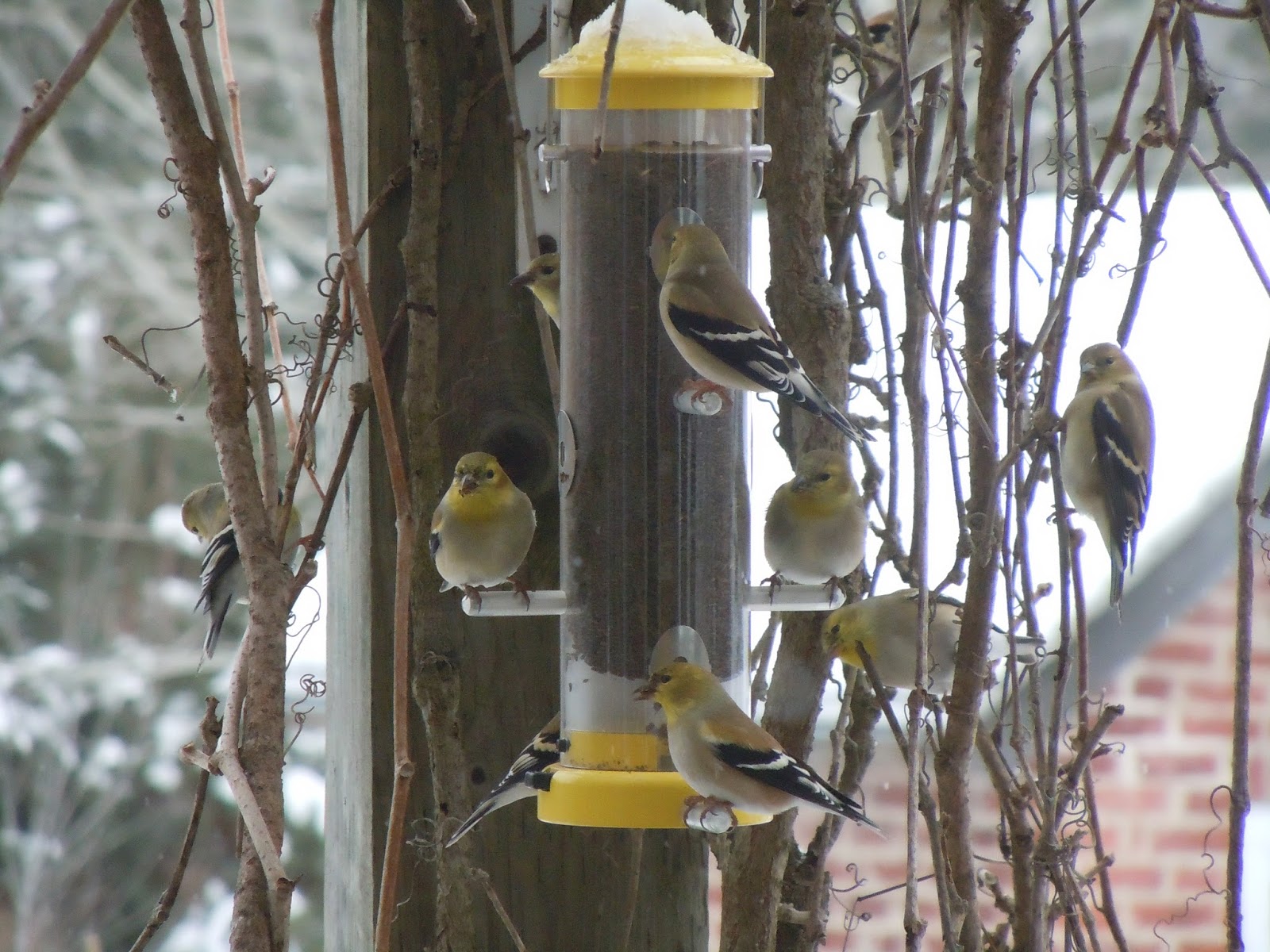
We arrived here Saturday around noon. Once we had unpacked and gotten the home fires burning Christopher went out to fill the bird feeders. Within minutes there were chickadees at the platform feeder. They are always the boldest and therefore the first. But shortly after they were joined by sparrows, finches and house finches and later blue jays.  It always takes a little longer for the juvenile finches to gather at the nyjer seed feeder Alex gave us for Christmas a few years ago.
Juvenile finches at the nyjer feeder. At this age both sexes are an olive green.
And other juvenile finches feeding on the spillover from the feeder above
I had gotten new skis and boots and, notwithstanding the temperature of -24C,  I was bound and determined to try them out. I was out for two and a half hours and got frost bite on my left ear lobe. That made me curious how those little birds could survive 24/7 in such brutal temperatures and arctic winds.
Trying the new gear in front of the bird feeder
Well it seems not all of them do. For some breeds about 75% of mature birds survive the winter vs 40% of the younger ones. Older birds are dominant socially and younger birds keep their distance from their belligerent elders. The safest and therefore preferred place to eat is the top of the trees - safest from  predators. The older birds get first dibs on this spot and the younger birds are forced to settle into the lower branches.

Simply put birds congregate in groups, eat - fatty foods if possible, fluff up their feathers at rest and hope for a cosy small cavity in which to overnight.

Notwithstanding selfish seniors, it is still true that birds of a feather really do flock together.
Generally there is safety in numbers - more eyes to be on the lookout for predators and better chances of finding the richest food sources. For wild birds eating at feeders the fattiest foods are best; black sunflower seeds, suet, peanuts. Even though squirrels are not predators birds give them a wide berth. When a red squirrel parks itself at our feeder some birds keep a vigilant eye from the safety of a nearby tree while others take the chance and eat the spilled seed on the ground below the feeder.
The red squirrel eyes the feeder from a nearby willow
Once the squirrel is nestled into the feeder the bolder birds gather below to eat spilled seed

Spots of yellow indicate an oriole and finch eyeing the feeder wistfully 
Like us, a big meal slows birds down making them more vulnerable to predators. If they've gotten their fill they take a rest and puff up their down feathers which help trap warm air in air pockets next to their bodies. Despite their misleading name, Downy (and all) woodpeckers don't have down feathers.
Finches at rest all puffed up while they "feather fluff"

Downy woodpecker at the suet feeder
Birds are also extremely susceptible to small changes in wind so they tend to congregate on the side of the tree away from the wind. If that side is also in the sun so much the better.
A blue jay preparing for a landing
Blue Jays also sample the suet while an oriole looks on

And finally, a roosting cavity just slightly larger than themselves helps the bird warm the surrounding air overnight. Other birds crowd together in a roosting cavity to share body heat. And others still can enter into a torpor-like state by lowering their metabolism to conserve energy and require less heat.

From year to year we have some loyal visitors like the mourning doves, chickadees and juncoes. Other birds are more discriminating I guess - trying us out but never to return for a second visit. This is the case with orioles - stunning citrus yellow birds bigger and brighter than the yellow and olive juvenile finches.
Orioles gather to eat seeds on the ground on Jan. 1, 2013
Birds also benefit from seed heads on perennials and homemade goodies like peanut butter pine cones. While this winter hasn't had the sustained cold and heavy snow of the last two years this weekend's deep freeze is only beaten by the record low set in 1899. Whatever the weather, birds can use all the help we can give them. And in return they reward us with colour and industrious activity in what can seem otherwise a monotone and lifeless winter landscape.