Showing posts with label canning tomatoes. Show all posts

Monday, 15 October 2012

storing vegetables for the winter

I happened to come across the ninjamatics Canadian Weblog Awards this morning. It sounded kind of fun. If you happen to be inclined to nominate this blog that would be lovely. Nominations for 2012 close Nov. 31 (which doesn't actually exist but I'll take the whole thing on faith...) Cooper Road CSA would probably be most appropriate for the Gardening and New Weblog categories. Here is the link

http://www.ninjamatics.com/canadian-weblog-awards  

Thank you in advance if you make a nomination!  But enough of distractions - time for this week's post.

 Now that we have had a hard frost and there is a remote, but real possibility of the ground freezing hard, it is the time to finish storing vegetables for the winter. There are many possibilities including freezing, canning, drying, storing in the fridge and in a root cellar and basement.

Canning
I have been a fan of canning for quite a few years. I like the fact that once you've finished processing the jars you don't need to consume any more energy to store them. Plus they can look quite beautiful.
Jellies and jams above, various kinds of heirloom tomato sauces below

Freezing
Originally we bought a freezer for the farmhouse to take advantage of buying meat and poultry from small local producers. These farmers generally butcher their meat two or three times a year only. A freezer turns out to be the only real way to keep a good stock of locally pasture raised meat and poultry. Buying from these farmers means you are supporting local sustainable agriculture and helping to make it a viable alternative to factory farmed, antibiotic and hormone infused, inhumanely raised livestock.

Freezers work most efficiently when full. Once we had one we found it to be a great way to freeze freshly picked fruit and berries, vegetables and all kinds of pesto.
Grated zucchini for an ongoing supply of chocolate zucchini cake and zucchini bread

Oven roasted Juliet tomatoes and green beans

Flash frozen strawberries, rhubarb and cultivated blueberries

Basil, mint and garlic scape pesto and chimichurri
The Fridge
I don't have a root cellar so I store my carrots and beets in perforated plastic bags in the crisper compartment of the fridge. If they aren't washed and are stored as soon as they are pulled from the ground they can stay crisp for months.
Freshly pulled carrots; orange, white, yellow, red and two kinds of purple
Basements
Potatoes and winter squash need to be harvested and then seasoned in the sun. Potatoes aren't washed and since they can start to be harvested in the summer it usually takes just an afternoon of warm August sun to harden the skins a little. I am lucky to have a basement with a dirt floor and high ceiling. The temperature in the fall and winter hovers just above freezing - perfect for storing potatoes. I hang them in net onion bags from nails. Different varieties vary in how long they keep - some until February or March and the French Fingerlings often keep until close to May.
Banana and French Fingerling potatoes

Winter squash also needs to be seasoned in the sun but this a bit trickier since they don't ripen until late September or even October. Since it wasn't warm or sunnier enough this fall I tried seasoning them in the window sills of my unheated front porch. They like to be stored on wooden shelves at a higher temperature than potatoes. So it's a bit of an experiment to see how they'll fare in the coolish basement.
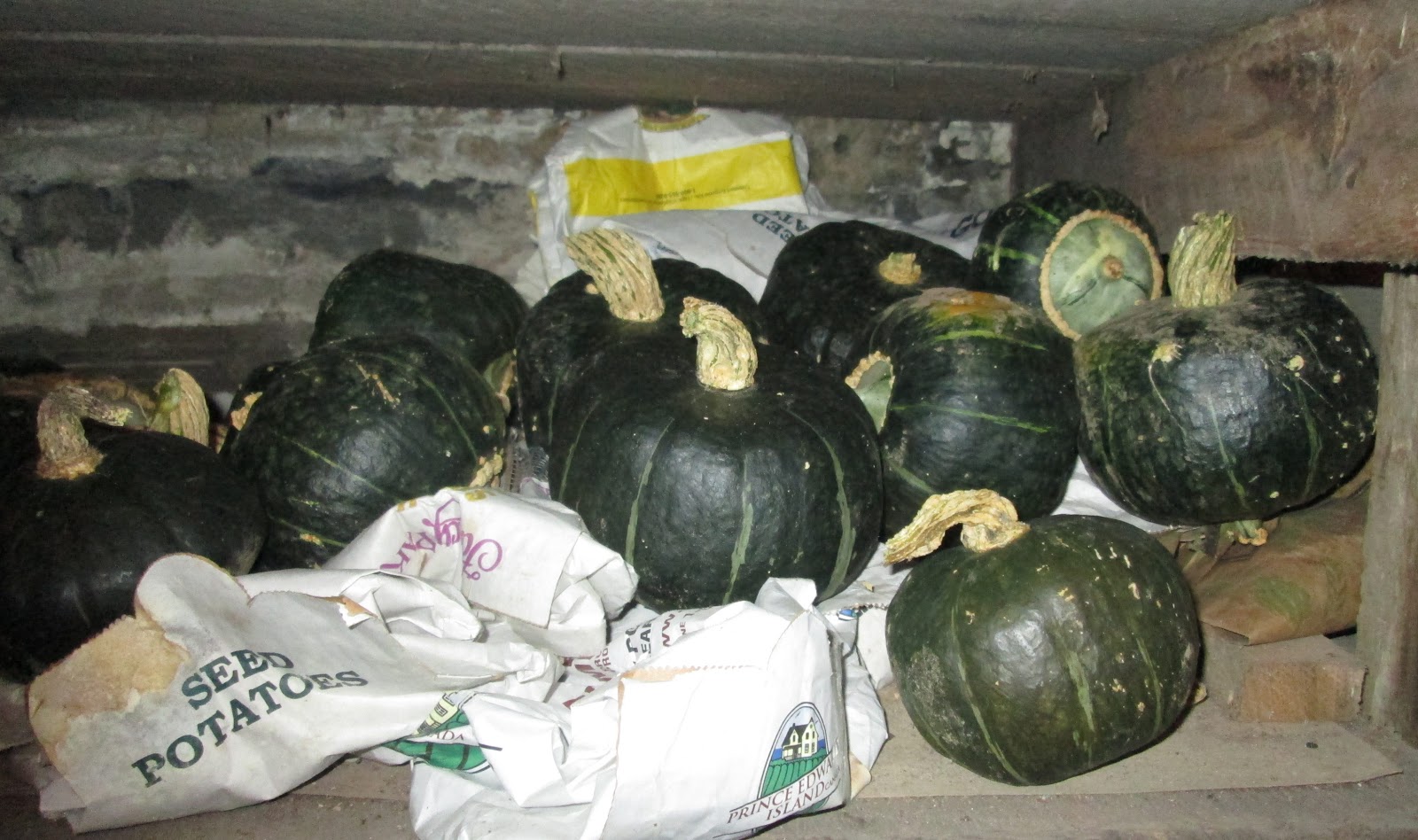
Buttercup squash, my favourite
Acorn Squash
Heeling in
This year I have tried pulling my leeks and "heeling them in".
Newly pulled leeks

You dig a trench and put the leeks in standing up (no need to trim the roots or clean them).

Then you cover much of them with soil from the trenches.
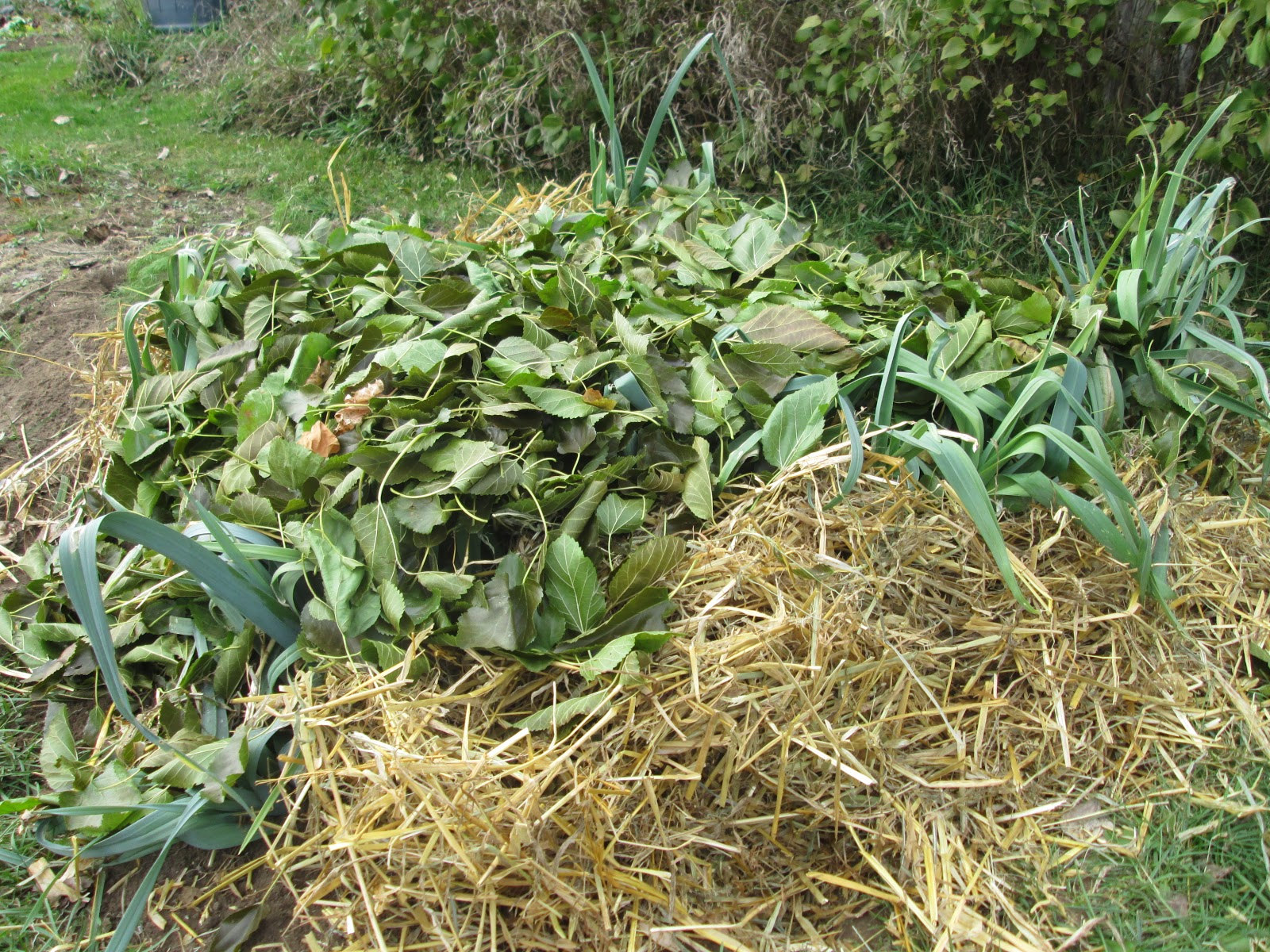
Next I placed straw on the outside "walls" and filled the whole area with fallen leaves. They should last for awhile but I'm not so sure about when we get deep snow. I guess we'll see if the supply of leeks lasts long enough for that to be an issue.

Drying
Heirloom shelling beans are shelled and dried on screens until you can't dent them with your thumb nail. Then they go into mason jars.

Tuesday, 4 September 2012

tomatoes

Every year I start plants of both hybrid and heirloom tomatoes. Because the heirlooms are open pollinated you can save the seed for next year's garden but hybrid seeds have to be purchased each year because they won't come true. Since every year is different the tomatoes that do the best each season vary. This particular year, with its sustained sun and minimal rain, seems to have made marked differences between the heirloom and hybrid tomatoes. The only full size hybrids I grew were Beefsteak which seem to pale in taste and texture to the heirlooms. But in the cherry, pear and currant tomatoes the comparison is less marked. The orange hybrid, Sun Sugar, cherry tomato is the sweetest. The heirloom Yellow Pear seems a little mealy and some of the heirloom small tomatoes seem to have been sweeter in previous years.

I should be more organized but I lose track of some of the varieties. Here's a sampling of what I can identify.
A variety of black tomatoes including Japanese Black Trifele  (the triangular ones at the bottom right)

The heirloom, Old German, in top basket, Sun Sugar in the middle basket
Hybrid Juliet tomatoes in the two right baskets
The rather bizarre white heirloom tomato, Ivory Queen, in the top basket , the Mexican Tlacalula below
Heirloom Persimmons in the top and heirloom Black Cherry below

First comes sowing seed, then planting, staking and pruning for best fruiting. And now, what to do with all those tomatoes..... So my kitchens have been very busy processing the past few days.

Juliet tomatoes ready to be oven toasted
The bountiful Juliet tomatoes, an AAS (All American Selection winner) hybrid with a plum shape and texture but smaller than standard roma tomatoes, is ideal for oven roasting. They are cut in half, laid out on a cookie sheet, drizzled with olive oil and sprinkled with sea salt and then slowly roasted at 250F for a couple of hours.
After slow roasting some of the moisture has evaporated, concentrating the flavour. They are then packed by the half pound in freezer bags.


I have been using many of the small tomatoes to make ketchup. The recipe is from Jamie Oliver's At Home cookbook. It is sort of laborious and time consuming but the flavour is worth it. The ingredients include the tomatoes and olive oil, celery, red onion, garlic, cloves, coriander seed, basil, salt and pepper. After reducing by half, the mixture is put through a sieve and then brown sugar and vinegar are added. The mixture is reduced again until the proper consistency is reached.

These bottles were made with yellow and orange cherry and pear tomatoes. 


And then finally there is the tomato sauce. I remember a description from one of my favourite books by Wayne Winterrowd with photos by Joe
Eck. A Year at North Hill: Four Seasons in a Vermont Garden. He made it sound like such a nice late summer tradition. While he was lucky enough to have a pottery bowl used exclusively for the annual tradition of making tomato sauce, I use big enamelled cast iron pots. This rough and ready sauce is appealing to me - no boiling the tomatoes to remove the skins or spending time taking out the seeds. You just chop the whole tomato and throw it in the pot.

Heirloom tomatoes are coarsely chopped and to these you add chopped garlic, olive oil and sea salt. Then  roast slowly (about 250F) in the oven - at least two hours will produce a flavourful but somewhat watery sauce. This is good for when you know you'll be cooking the sauce more when it is ready to be used (like in a braise). For a thicker sauce to be heated and thrown over pasta, you simply leave the tomatoes in the oven longer. The top surface roasts turning a lovely brown. It is good to press the tomatoes against the side every once in a while to break them up and release the juices. And then it's time to start canning. I like to make batches of individual types so I have jars of black, yellow, orange and red. I don't think the flavour varies much but they look so nice in jewel tones on the pantry shelf. I also make a separate plum tomato sauce for chili.

We always aspire to make at least 50 jars. I'm not sure we've ever made it but I think chances are pretty good this year!