But, not to be daunted by the difficulties, endless experimenting may just pay off occasionally.
I think the one success I can make a claim to, year in and year out, is spring greens. I just love heirloom lettuces. I love them for their variety and their beauty,

| Red oakleaf on the left and Black Seeded Simpson on the right |
 |
| from back to front; Bibb, Marveille and Green Oakleaf |
 |
| Bibb |

to the Impressionist looking wine and green of Marveille de Quatre Saisons.

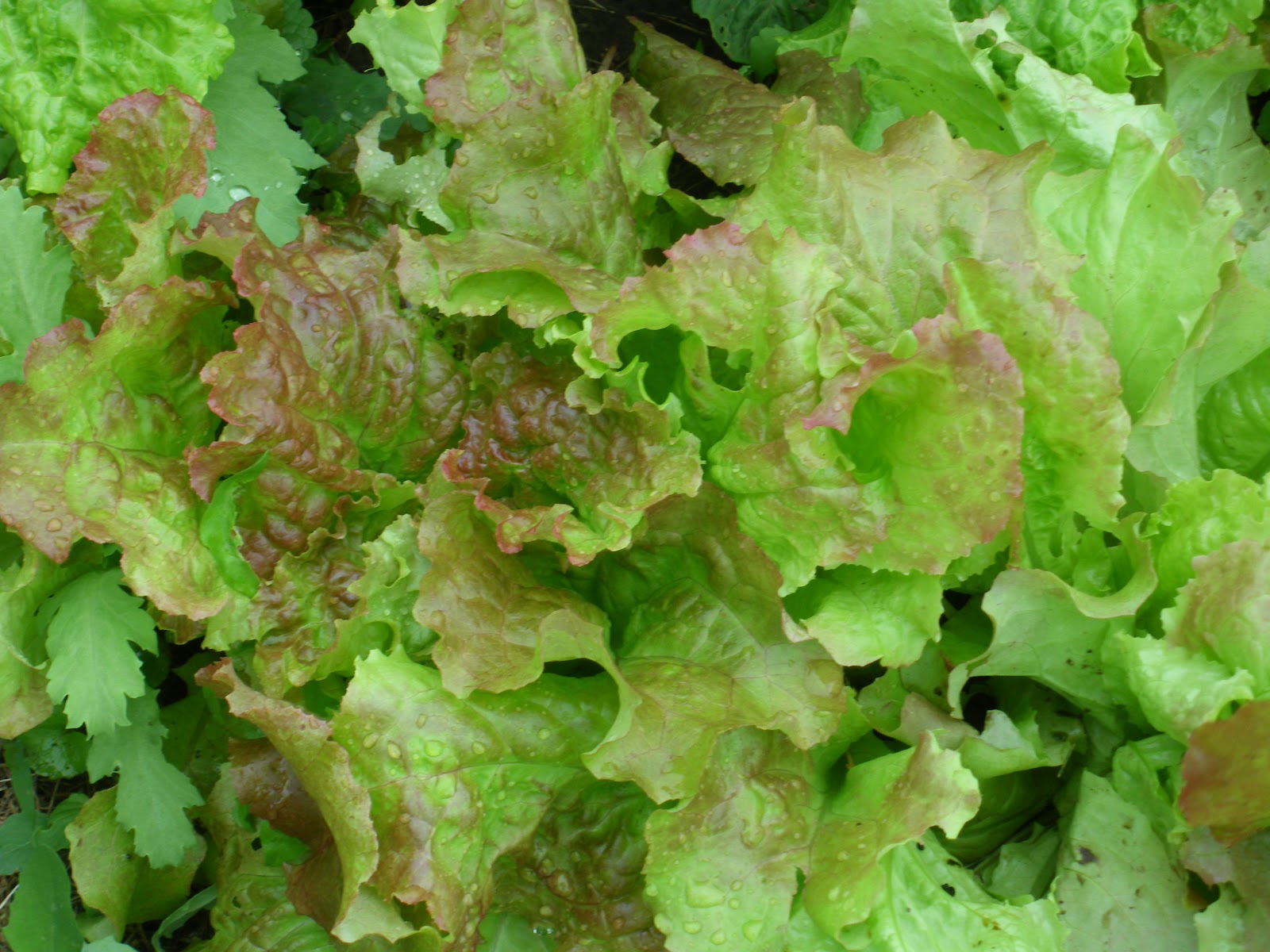
Then there is Freckles, the green Romaine with red spots. But actually, Freckles is a Romaine type, and this is clearly an oak leaf. So maybe I've inadvertently created a new lettuce. How about Comedo Oakleaf (I know, who knew, but look it up!)? The other possibility with open pollinated plants is that they can cross breed, taking characteristics from each of the "parent" plants, in this case it would be Freckles Romaine and Green Oakleaf, and create a new plant. But the seed from the new plant, let's say our Comedo Oakleaf, would not come true. And thus a hybrid has been created. The progeny could reflect any combination of characteristics from the two gene pools that created it.

 |
| Green Oakleaf |
and its sister, the Red Oakleaf.

But the other reason I love heirloom lettuces is that they are open pollinated. This means if you let them flower and then go to seed, those seeds will produce the exact same plant when germinated.
I always try to collect seed, but I'm not organized enough to label the plants before they flower. Despite the difference in their appearance at the beginning of the season, by the time they are setting seed all the leaves look the same and all the flowers are a pale yellow daisyish shape.
But sometimes the lazy way turns out to be the best too. For the lettuce seeds that escape my attempts to capture them when conditions are exactly right they start germinating. They do this at different rates, and because they have withstood the tortures of winter but have also been coddled by a blanket of heavy snow, they are tough and independent little foundlings. No matter what vagaries spring brings they thrive and grow strong and true.
After a few weeks I start transplanting them into orderly rows with lots of compost and manure added to each hole and a bed of grass clippings to mulch them. No matter how early I plant seeds, whether started indoors in flats or direct seeded into the garden, these lettuces just never seem to have the strength of character the foundling self-starters do.
 |
| Direct seeded Lolla Rossa on the left and various self seeded lettuces on the right |
The other experiment which has worked out well for me is to plant "winter" spinach. I sow the seeds in the late fall. Sometimes they will germinate in the late autumn, sometimes not, but by spring I have a full crop of spinach which has done its work producing leaves and is just starting to go to seed when the first seeding of spring spinach has just started to produce its secondary leaves.
 |
| "Winter" spinach about to go to seed |
 |
| Direct seeded spring lettuce |