Showing posts with label spinach. Show all posts

Thursday, 6 June 2013

Heirloom lettuces and "Winter" spinach

Growing vegetables is always a challenge - swings in temperature in the spring, drought or deluge in the summer, getting the right balance of "good" and "bad" insects. And, for me , the additional challenge of not living full time where my garden is. A greenhouse would be nice, but without someone there to regulate temperature and humidity, that is out of the question.

But, not to be daunted by the difficulties,  endless experimenting may just pay off occasionally.

I think the one success I can make a claim to, year in and year out, is spring greens. I just love heirloom lettuces. I love them for their variety and their beauty,


Red oakleaf on the left and Black Seeded Simpson on the right

from back to front; Bibb, Marveille  and Green Oakleaf
 everything from robust oval leaves as in Bibb
Bibb
to the chartreuse green frilliness of Black Seeded Simpson


to the Impressionist looking wine and green of Marveille de Quatre Saisons.


Then there is Freckles, the green Romaine with red spots. But actually, Freckles is a Romaine type, and this is clearly an oak leaf. So maybe I've inadvertently created a new lettuce. How about Comedo Oakleaf (I know, who knew, but look it up!)? The other possibility with open pollinated plants is that they can cross breed, taking characteristics from each of the "parent" plants, in this case it would be Freckles Romaine and Green Oakleaf, and create a new plant. But the seed from the new plant, let's say  our Comedo Oakleaf, would not come true. And thus a hybrid has been created. The progeny could reflect any combination of characteristics from the two gene pools that created it.


Green Oakleaf


and its sister, the Red Oakleaf.

But the other reason I love heirloom lettuces is that they are open pollinated. This means if you let them flower and then go to seed, those seeds will produce the exact same plant when germinated.

I always try to collect seed, but I'm not organized enough to label the plants before they flower. Despite the difference in their appearance at the beginning of the season, by the time they are setting seed all the leaves look the same and all the flowers are a pale yellow daisyish shape.

But sometimes the lazy way turns out to be the best too. For the lettuce seeds that escape my attempts to capture them when conditions are exactly right they start germinating. They do this at different rates, and because they have withstood the tortures of winter but have also been coddled by a blanket of heavy snow, they are tough and independent little foundlings. No matter what vagaries spring brings they thrive and grow strong and true.

After a few weeks I start transplanting them into orderly rows with lots of compost and manure added to each hole and a bed of grass clippings to mulch them. No matter how early I plant seeds, whether started indoors in flats or direct seeded into the garden, these lettuces just never seem to have the strength of character the foundling self-starters do.
Direct seeded Lolla Rossa on the left and various self seeded lettuces on the right

The other experiment which has worked out well for me is to plant "winter" spinach. I sow the seeds in the late fall. Sometimes they will germinate in the late autumn, sometimes not, but by spring I have a full crop of spinach which has done its work producing leaves and is just starting to go to seed when the first seeding of spring spinach has just started to produce its secondary leaves.
"Winter" spinach about to go to seed
Direct seeded spring lettuce


Tuesday, 9 October 2012

The garden on Thanksgiving and planting garlic

It really felt like the season changed from early to late fall this Thanksgiving weekend. The trees were ablaze on Saturday and Sunday, the skies moody with clouds punctuated by pockets of sun. And then it went down to -6C over Sunday night. By Monday morning you could actually hear the trees raining their frost rimed leaves.
Late afternoon on Thanksgiving weekend

This was the turning point weekend. Some vegetables like kale, carrots, beet greens and leeks appreciate a bit of frost to bring out their sweetness. There is always a bit of uncertainty about when to harvest winter squash; people seem sharply divided about whether it is just before or after a light frost.  Regardless of the point of view, this seemed like the time to bring in any squashes left in the garden.
Bull's Blood Beet Greens

There was no question about the snap and shelling beans. I picked what were ready on Saturday and by Monday morning those left on the plants had turned to mush.
The new greens bed

The greens have made a comeback; heirloom lettuces, spinach, sorrel, even some self seeded peas.  They will withstand ground frost and keep growing, albeit a little modestly, until the ground freezes hard and daytime temperatures hover close to 0C. All spring and summer I kept seeding kale and mustard. The germination rate was minimal and those few that did grow were ravaged by insect damage. The past few weeks we have had the cool temperatures and moisture they have been craving all along. Their happiness shows in the big, deeply coloured leaves with almost no insect damage. It's interesting how over and over again the healthiest plants have little problem with insects. It is always the weak and sickly plants that are then further disadvantaged by damage from pests and diseases.
Red Russian Kale

October is the month to plant garlic - with the optimum date being on the full moon. With two this year you'd think I could have managed to accommodate either the one on Oct. 1 or the blue moon on Oct. 29. But I was away at the beginning of the month. And with the heavy frost on Sunday night I felt like an anxious mother wringing my hands, wondering if the ground might be frozen solid by the end of the month. So the garlic went in on Monday.
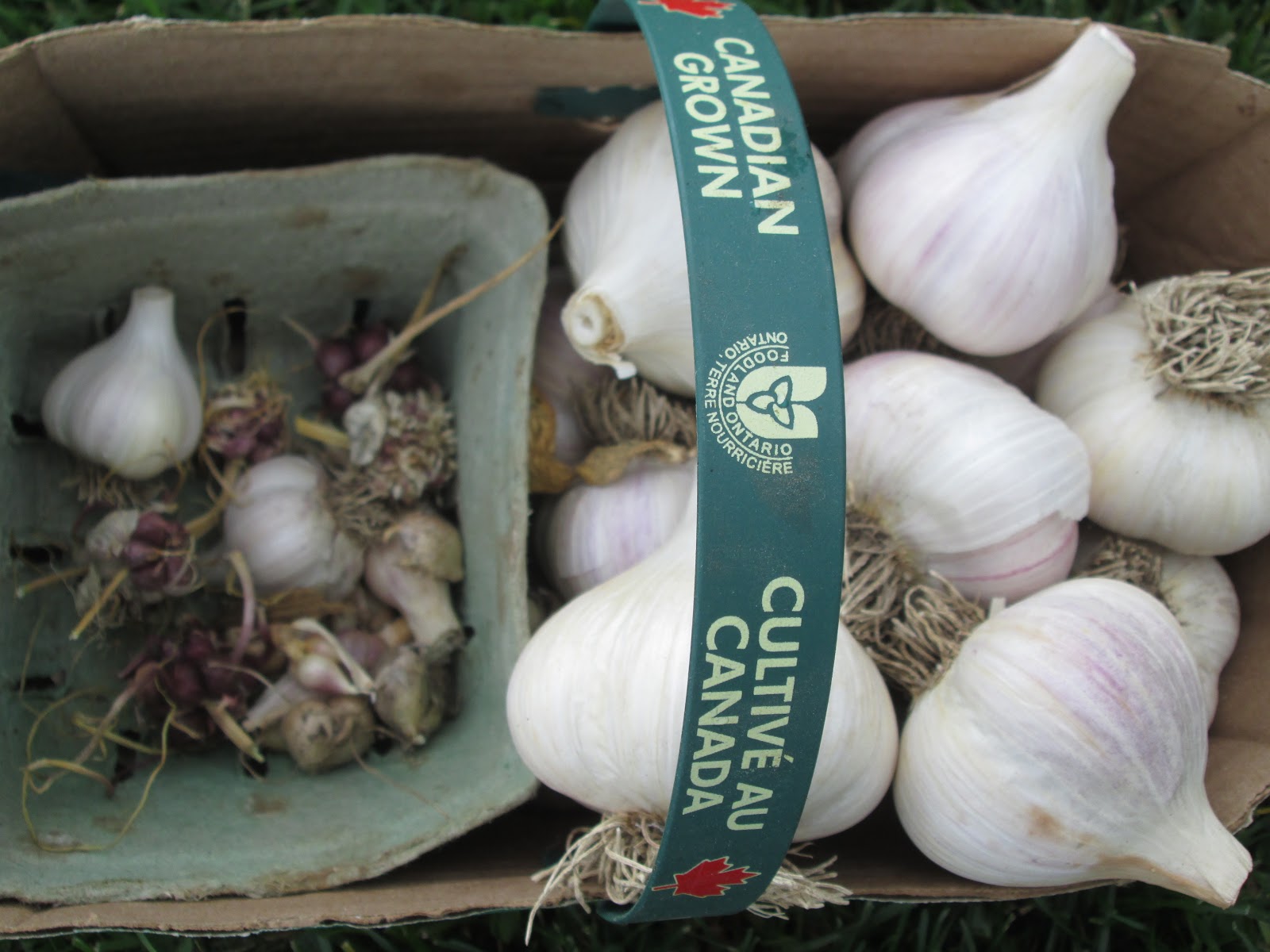
Seed garlic, the new stock on the left and the mature heads on the right

After the freshly harvested garlic has been hung to air dry for  a couple of weeks and you're ready to store it for the winter, you choose your best heads to use as seed. It is also a good idea to plant some bulbils if you have let some of the garlic flower and go to seed. These little bulbils become new seed for the future  - a way of ensuring your stock stays healthy and is less likely to become prey to ongoing pest and disease problems.

A clove ready to be planted, flat end down
A few weeks ago I had added manure and compost to the bed destined for this year's garlic. When it was time to plant I scattered more manure in rows, then used the long handled cultivator to mix it in and loosen the soil. Each head is divided into its separate cloves. The cloves are planted a couple of inches deep with the flat part down. Garlic is really very forgiving so it is not crucial to worry about the space between cloves or the rows for that matter.
The new garlic bed clothed in its blanket of fall leaves

Other years I have planted the garlic much earlier and so have used grass clippings for mulch. This year I tried raking the leaves of the catalpa and mulberry which were close to hand and abundant. They seem a little big and fibrous compared to other deciduous leaves. But they will help keep reduce the fluctuations in temperature we experience at this time of year. And I'm going to count on them having broken down by next spring when the first green sprouts emerge. At that point the leaf mulch will help keep the weeds down. Being shallow rooted, garlic doesn't cope well with weeds. Nor do gardeners cope well with trying to hoe the weeds without uprooting the garlic we're trying to help.

Thursday, 12 April 2012

planting peas and spinach

It's been such a non-winter that I'm going to take a chance and start planting peas and spinach. Certainly the ground can be worked which is when they always say you can start planting cool weather crops. In fact I think the theme this summer is going to be drought. Railway Creek, which runs along the south border of our property, is already very low and the ground is really quite dry even this early.

Pea support in place
I decided to put the peas in the bed where I've had tomatoes the last two years. As nitrogen-fixers, they should replenish nutrients and restore a little of the fertility. I started out by digging out the poplar roots which have become the (most recent) bane of my existence along the north edge of the bed.  I've spent so many years building up the soil in the vegetable beds I can't bear the thought of giving up on them. My husband, Christopher,  helped move the support for the tall peas into place. Because it is so dry I decided to put semi-frozen manure into the rows hoping as it melts it will add much needed moisture (or alternatively everything will just rot and I'll have to replant!) This weekend I started with Lincoln Homesteader, Sugar Snap, Sugar Lace and Alaska peas and Longstanding Bloomsdale spinach at the foot of the peas.

Over the next few weeks I'll add Laxton's Progress, Little Marvel and Green Arrow peas and Dwarf Grey Sugar for pea shoots and tendrils. There is also a nice purple snow pea called Desiree and a yellow snow pea called Golden. For support for the bush peas I like to use prunings from the highbush cranberry. They're nice and twisty and offer lots of branches for the peas to grab hold and twist their way up.

I find it's a good idea to plant different varieties, both open pollinated heirlooms and hybrids, since various types fare differently in the unpredictable vagaries of the weather. In addition to more of the Bloosmdale spinach I'll also plant Tyee, Space and a lovely hybrid called Bordeaux which has red veins.