One of the memories from my time in high school that I share with my mother is of my Grade 12 English teacher who famously said, "Women always resort to speaking in cliches". This rather contentious statement brought my mother and I closer because of our shared outrage - on two counts. Not only was it denigrating and incorrect as far as the implied incapacity of women to be articulate and in their own words. But we both felt that cliches, proverbs and idioms all had their place enriching spoken language. I guess in this respect "the apple didn't fall far from the tree".
But I'm "putting the cart before the horse".
Now that it's the last day of October it feels like the long haul of winter is upon us - long days spent indoors with more time for reflection and contemplation.
It occurs to me that certain activities are particularly rich sources for the vernacular; war comes to mind - think "nosedive", "SNAFU"and "blitz"(krieg) from WWII, "brainwashing" from the Korean War and the Gulf War gave us "collateral damage". All these terms have entered the lexicon and are used in non-military contexts, understood by all. Another fertile area, more for proverbs and idioms, is agriculture. Like the military terms, they were rather literal originally, but have been transformed over time to have much more general applications quite separate from their agrarian origins.
At the beginning of each gardening season, as I turn the soil and then plant row after row of seeds, I am reminded of how I'm supposed to "reap what I sow". And my response is "if only". Take the hotboxes for example. After constructing them, filling them with manure, soil and compost, raising the peppers and eggplants from seed and finally transplanting them, it was almost all for nought. The chipmunks have had a population explosion. And they decided they had discovered their own personal "low hanging fruit" in the hotboxes. Virtually all the plants were gnawed off at the surface. I'm not one to "cry over spilt milk". So I wondered if I could reinvent the hotboxes as cold frames - may as well "kill two birds with one stone". A couple of weeks ago I planted them with dozens of lettuce seedlings and covered the tops with old windows. Last weekend I saw that the chipmunks had dug new burrows in front of the hotboxes and then tunnelled up right through them to the surface and eaten all the lettuces. It was definitely time to wage war! But I know that's a little like "shutting the barn door after the horses are out".
Since no pesticides, insecticides or herbicides are used in the garden it may seem a little inconsistent to some that I want to reduce my surplus chipmunk population. I suspect these same people may have no problem with getting rid of slugs and earwigs or even setting mouse traps. While it may have been more prudent to keep my lethal intentions to myself "I may as well be hanged for a sheep as a lamb".
The hotboxes were not a success but this season did have some triumphs - it was a great year for tomatoes and beans. Greens were difficult all spring and summer but finally did well this fall. I've gardened long enough to know every year is different and "you can never count your chickens before they hatch".
The CSA is not my only source of income - I could "never put all my eggs in one basket".
When I'm wearing my other hat as a private music teacher, my students will occasionally play something at an unbearably slow tempo. I often tell them it is "as slow as molasses in January". Never having heard the expression they both get the point and, rather than taking offence, are often amused. I guess "you can catch more flies with honey than vinegar".
As I look out the window and see all the rain and remember the halcyon days of summer, I forget the heat and drought, the aches and pains, the disappointments and frustrations. I guess "faraway pastures are always greener".
I'm thinking that all this rain has given me a bit of cabin fever and made me a little silly. I'm wondering if other people may feel the same. I guess I'm hoping that "what's good for the goose is good for the gander".
Oh well, all is just "grist for the mill"...
Trick or Treat ! (Not sure it's either - but as my mother says, "Nothing ventured, nothing gained".)
Happy Hallowe'en!
Wednesday, 31 October 2012

Thursday, 18 October 2012
Three Seasonal Recipes
I thought I would highlight three vegetables which really shine in the fall.
Raw Kale Salad
Kale is often sauteed, or wilted, even when used in a salad. It doesn't really have to be cooked but, it does benefit (as we all do), from a massage. Most recipes recommend the stems be removed but I've also included them - and lived to tell the tale. In some ways I think of this salad as a vegetable ceviche since I think the kale really needs citrus juice added ahead of serving time to help break down the fibres. And finally, since I am a lover all three major food groups; salt, sugar and fat, I like to add pecorino or feta cheese, dried cranberries or some other dried fruit and nuts which are even better if you toast or candy them.
One Bunch of Kale (cavallo nero or Red Russian)
Lemon juice (and lemon zest if you want it really lemony)
Olive oil
Sea salt
Dried cranberries, raisins or other dried fruit
Grated pecorino, feta or chunks of avocado
Remove the stems of the kale. Roll the leaves like a cigar and slice into thin ribbons. Add olive oil, lemon juice and sea salt. Massage. The kale will turn a darker green.
 |
| Red Russian Kale |
If you're adding dried fruit you can add it now and it will absorb the vinaigrette and plump up as the salad rests. I like to take the salad out of the fridge at least an hour before serving so it can come to room temperature.
Just before serving add cheese or avocado chunks.
 |
| Raw Kale Salad with dried cranberries, lemon juice and zest, tamari almonds and grated pecorino |
Leek and Smoked Salmon Tart
This recipe is inspired by John Bishop of Bishop's Restaurant in Vancouver which is known for its use of local products provided by farmers who practise sustainable farming.
Leeks, about 2 cups sliced or three largish leeks
Smoked Salmon
Prebaked Pie shell
Chives (optional)
4 farm fresh eggs
2 cups light cream or 1 cup whipping cream and 1 cup milk
Slice off the root end of the leeks and slice vertically down the leaves to help rinse any dirt hiding in the foliage. Slice across the leeks into coins - you can use the leaves as well as the white part. Saute gently in butter until tender.
 |
| Washed and chopped leeks |
Spread the leeks in the prebaked pie shell and top with pieces of smoked salmon. At this point you can also add chopped chives, dill or another herb of our preference. I used garlic chives because I had them at hand in the garden.
 |
| Pieces of smoked sockeye salmon and garlic chives added |
Add four eggs to the cream mixture and whisk until it is mixed ( it will thicken a little too).
Pour the egg and cream mixture over the leeks and smoked salmon.
 |
| The whisked cream and egg mixture added |
Bake at 350 for about 45 minutes. It will puff a little and the top will turn golden.
 |
| Leek and Smoked Salmon Tart fresh out of the oven |
Let it rest a few minutes before serving.
Scalloped Potatoes with Gruyere Cheese and Boar Smoked Ham
This is sort of an amalgamation of Scalloped Potatoes and Potatoes Dauphinoise
Potatoes
Gruyere Cheese
Leek Coins sauteed in butter or sliced onions (optional)
Cream or milk
Ham
Butter
Sea salt and freshly ground pepper
Smoked or regular paprika
The potatoes are washed and sliced.
Grate the cheese.
Tear the ham into smallish pieces. We had baked a smoked boar ham we got in Thunder Bay in July. Since it had been vacuum packed there was no problem with it keeping more or less indefinitely in the fridge.
Saute the chopped leeks or onions in a little butter.
Butter a shallow baking dish or enamelled pot.
And assemble. Start with a layer of potatoes on the bottom. Then alternate with ham and cheese and leeks is using. Finish with potatoes on top. I like to grind the salt and pepper on top and sprinkle with paprika. Then pour the cream/milk over the top and it will wash some of the salt mixture down through the layers. The dot with butter.
Cover with a lid. Bake at 350 for about 45 minutes and then remove the lid and bake for a further 10 to 15 minutes until the top has browned.
This is sort of an amalgamation of Scalloped Potatoes and Potatoes Dauphinoise
Potatoes
Gruyere Cheese
Leek Coins sauteed in butter or sliced onions (optional)
Cream or milk
Ham
Butter
Sea salt and freshly ground pepper
Smoked or regular paprika
The potatoes are washed and sliced.
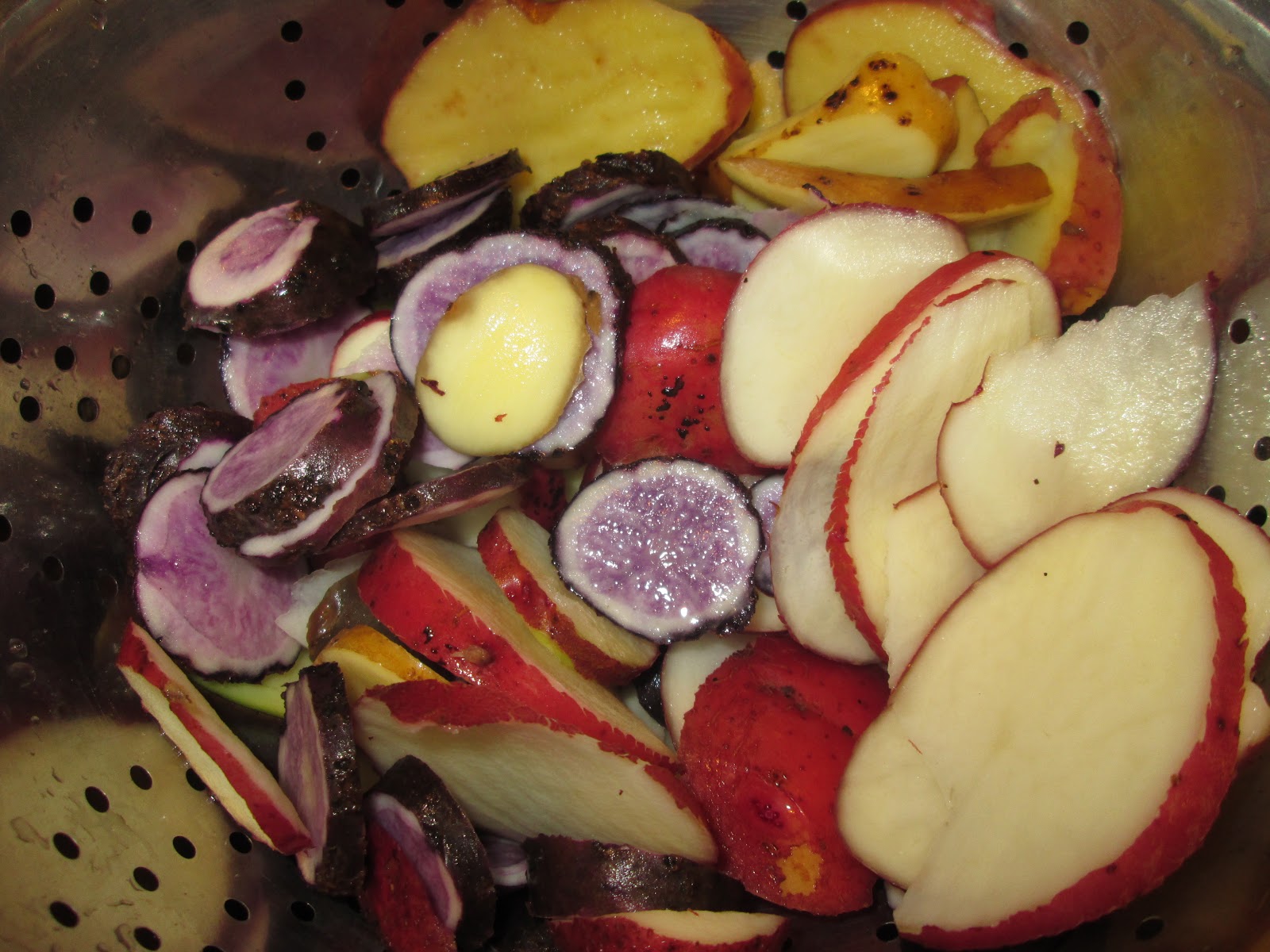 |
| I had a mixture of Dark Red Norland, Blue and French Fingerling potatoes |
Grate the cheese.
 |
| Grated Gruyere and sliced Boar Ham |
Tear the ham into smallish pieces. We had baked a smoked boar ham we got in Thunder Bay in July. Since it had been vacuum packed there was no problem with it keeping more or less indefinitely in the fridge.
Saute the chopped leeks or onions in a little butter.
 |
| Sauteed leeks |
Butter a shallow baking dish or enamelled pot.
And assemble. Start with a layer of potatoes on the bottom. Then alternate with ham and cheese and leeks is using. Finish with potatoes on top. I like to grind the salt and pepper on top and sprinkle with paprika. Then pour the cream/milk over the top and it will wash some of the salt mixture down through the layers. The dot with butter.
 |
| Ready to go in the oven |
Cover with a lid. Bake at 350 for about 45 minutes and then remove the lid and bake for a further 10 to 15 minutes until the top has browned.
 |
| Dinner is ready! |
Monday, 15 October 2012
storing vegetables for the winter
I happened to come across the ninjamatics Canadian Weblog Awards this morning. It sounded kind of fun. If you happen to be inclined to nominate this blog that would be lovely. Nominations for 2012 close Nov. 31 (which doesn't actually exist but I'll take the whole thing on faith...) Cooper Road CSA would probably be most appropriate for the Gardening and New Weblog categories. Here is the link
http://www
Thank you in advance if you make a nomination! But enough of distractions - time for this week's post.
Now that we have had a hard frost and there is a remote, but real possibility of the ground freezing hard, it is the time to finish storing vegetables for the winter. There are many possibilities including freezing, canning, drying, storing in the fridge and in a root cellar and basement.
Canning
I have been a fan of canning for quite a few years. I like the fact that once you've finished processing the jars you don't need to consume any more energy to store them. Plus they can look quite beautiful.
Freezing
Originally we bought a freezer for the farmhouse to take advantage of buying meat and poultry from small local producers. These farmers generally butcher their meat two or three times a year only. A freezer turns out to be the only real way to keep a good stock of locally pasture raised meat and poultry. Buying from these farmers means you are supporting local sustainable agriculture and helping to make it a viable alternative to factory farmed, antibiotic and hormone infused, inhumanely raised livestock.
Freezers work most efficiently when full. Once we had one we found it to be a great way to freeze freshly picked fruit and berries, vegetables and all kinds of pesto.
The Fridge
I don't have a root cellar so I store my carrots and beets in perforated plastic bags in the crisper compartment of the fridge. If they aren't washed and are stored as soon as they are pulled from the ground they can stay crisp for months.
Basements
Potatoes and winter squash need to be harvested and then seasoned in the sun. Potatoes aren't washed and since they can start to be harvested in the summer it usually takes just an afternoon of warm August sun to harden the skins a little. I am lucky to have a basement with a dirt floor and high ceiling. The temperature in the fall and winter hovers just above freezing - perfect for storing potatoes. I hang them in net onion bags from nails. Different varieties vary in how long they keep - some until February or March and the French Fingerlings often keep until close to May.
Winter squash also needs to be seasoned in the sun but this a bit trickier since they don't ripen until late September or even October. Since it wasn't warm or sunnier enough this fall I tried seasoning them in the window sills of my unheated front porch. They like to be stored on wooden shelves at a higher temperature than potatoes. So it's a bit of an experiment to see how they'll fare in the coolish basement.
Heeling in
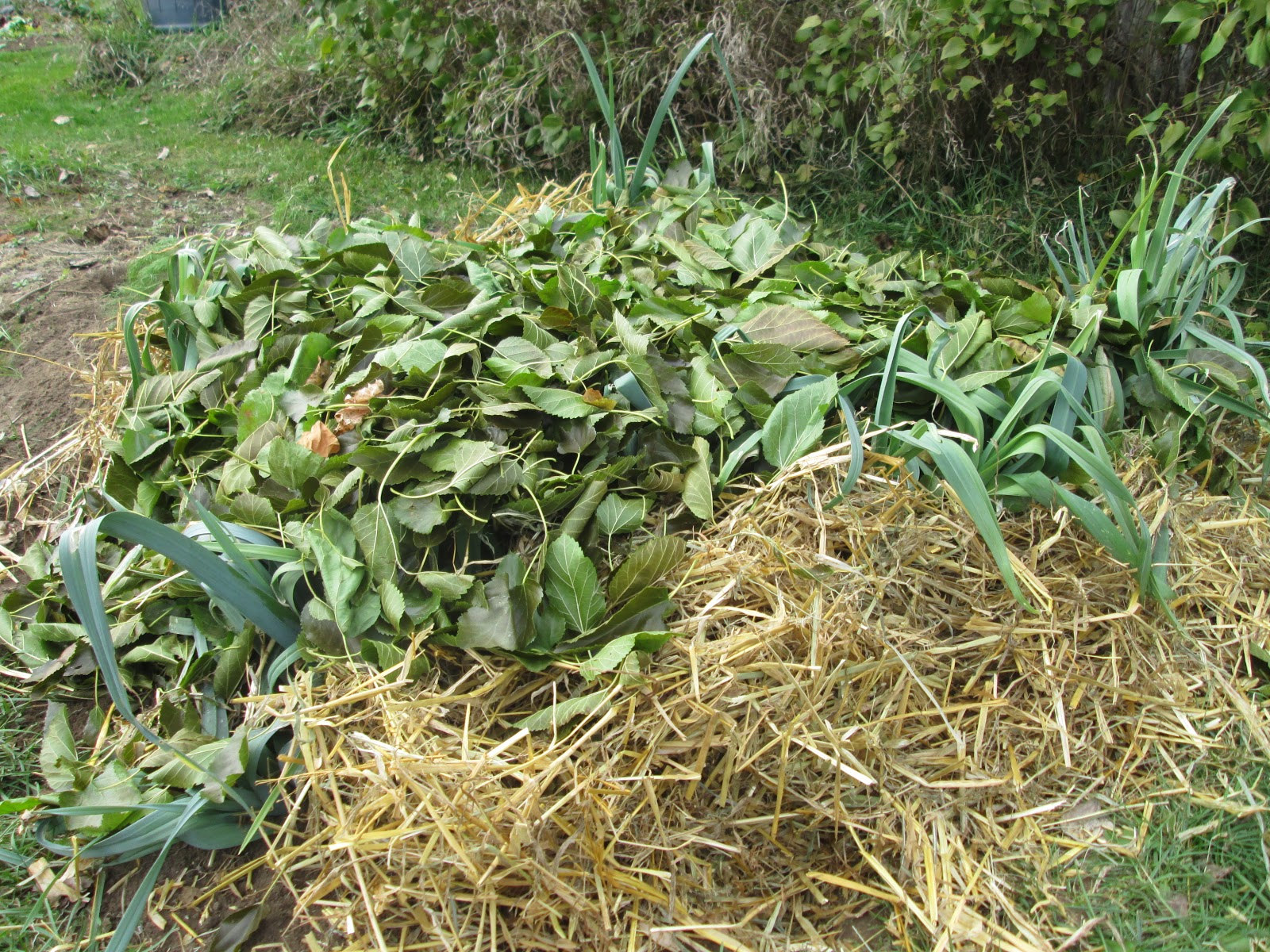
This year I have tried pulling my leeks and "heeling them in".
You dig a trench and put the leeks in standing up (no need to trim the roots or clean them).

Then you cover much of them with soil from the trenches.
 Next I placed straw on the outside "walls" and filled the whole area with fallen leaves. They should last for awhile but I'm not so sure about when we get deep snow. I guess we'll see if the supply of leeks lasts long enough for that to be an issue.
Drying
Heirloom shelling beans are shelled and dried on screens until you can't dent them with your thumb nail. Then they go into mason jars.

http://www
Thank you in advance if you make a nomination! But enough of distractions - time for this week's post.Now that we have had a hard frost and there is a remote, but real possibility of the ground freezing hard, it is the time to finish storing vegetables for the winter. There are many possibilities including freezing, canning, drying, storing in the fridge and in a root cellar and basement.
Canning
I have been a fan of canning for quite a few years. I like the fact that once you've finished processing the jars you don't need to consume any more energy to store them. Plus they can look quite beautiful.
 |
| Jellies and jams above, various kinds of heirloom tomato sauces below |
Freezing
Originally we bought a freezer for the farmhouse to take advantage of buying meat and poultry from small local producers. These farmers generally butcher their meat two or three times a year only. A freezer turns out to be the only real way to keep a good stock of locally pasture raised meat and poultry. Buying from these farmers means you are supporting local sustainable agriculture and helping to make it a viable alternative to factory farmed, antibiotic and hormone infused, inhumanely raised livestock.
Freezers work most efficiently when full. Once we had one we found it to be a great way to freeze freshly picked fruit and berries, vegetables and all kinds of pesto.
 |
| Grated zucchini for an ongoing supply of chocolate zucchini cake and zucchini bread |
 |
| Oven roasted Juliet tomatoes and green beans |
 |
| Flash frozen strawberries, rhubarb and cultivated blueberries |
 |
| Basil, mint and garlic scape pesto and chimichurri |
 |
| Freshly pulled carrots; orange, white, yellow, red and two kinds of purple |
Potatoes and winter squash need to be harvested and then seasoned in the sun. Potatoes aren't washed and since they can start to be harvested in the summer it usually takes just an afternoon of warm August sun to harden the skins a little. I am lucky to have a basement with a dirt floor and high ceiling. The temperature in the fall and winter hovers just above freezing - perfect for storing potatoes. I hang them in net onion bags from nails. Different varieties vary in how long they keep - some until February or March and the French Fingerlings often keep until close to May.
 |
| Banana and French Fingerling potatoes |
Winter squash also needs to be seasoned in the sun but this a bit trickier since they don't ripen until late September or even October. Since it wasn't warm or sunnier enough this fall I tried seasoning them in the window sills of my unheated front porch. They like to be stored on wooden shelves at a higher temperature than potatoes. So it's a bit of an experiment to see how they'll fare in the coolish basement.
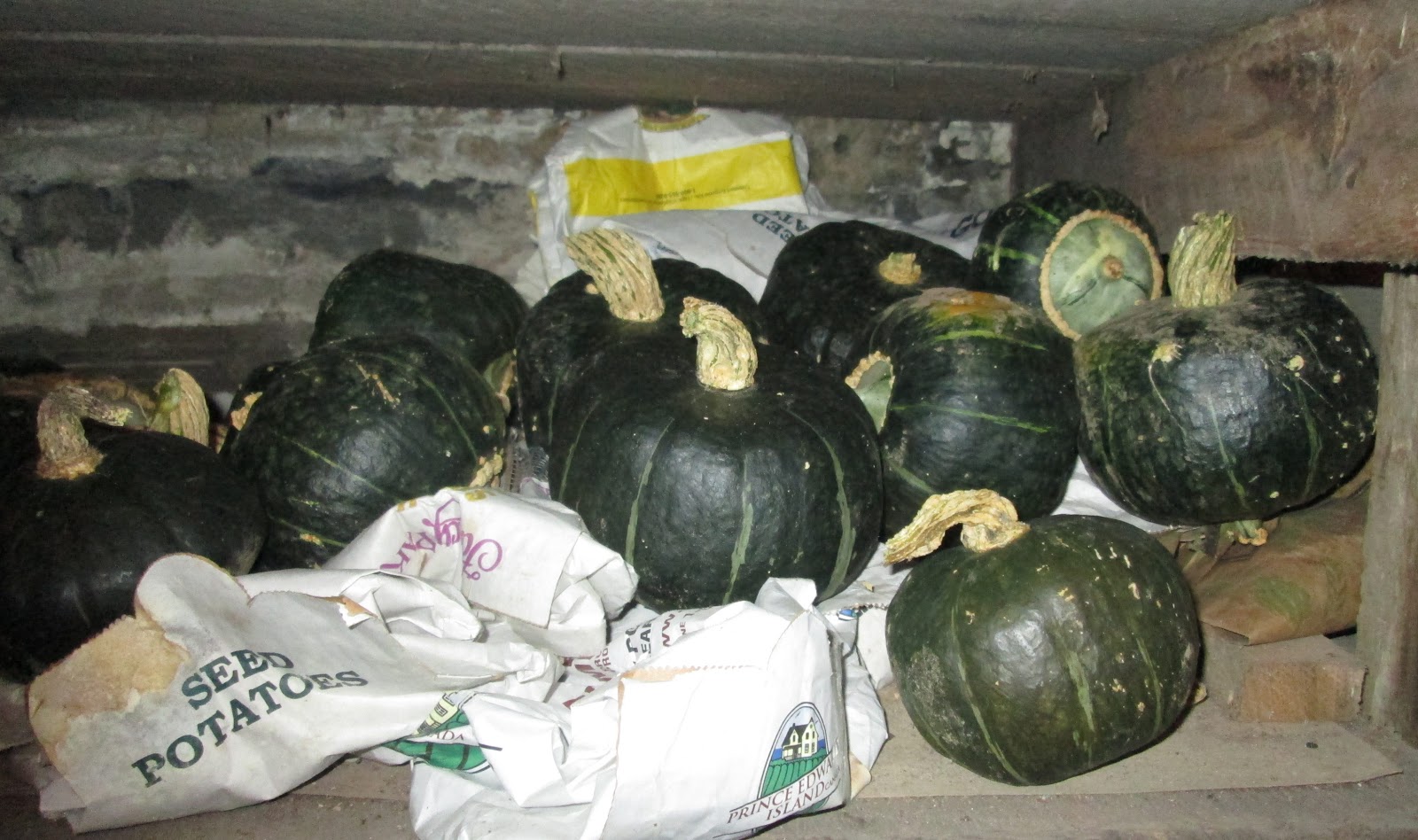 |
| Buttercup squash, my favourite |
 |
| Acorn Squash |
This year I have tried pulling my leeks and "heeling them in".
 |
| Newly pulled leeks |
You dig a trench and put the leeks in standing up (no need to trim the roots or clean them).

Then you cover much of them with soil from the trenches.
Drying

Tuesday, 9 October 2012
The garden on Thanksgiving and planting garlic
It really felt like the season changed from early to late fall this Thanksgiving weekend. The trees were ablaze on Saturday and Sunday, the skies moody with clouds punctuated by pockets of sun. And then it went down to -6C over Sunday night. By Monday morning you could actually hear the trees raining their frost rimed leaves.
This was the turning point weekend. Some vegetables like kale, carrots, beet greens and leeks appreciate a bit of frost to bring out their sweetness. There is always a bit of uncertainty about when to harvest winter squash; people seem sharply divided about whether it is just before or after a light frost. Regardless of the point of view, this seemed like the time to bring in any squashes left in the garden.
There was no question about the snap and shelling beans. I picked what were ready on Saturday and by Monday morning those left on the plants had turned to mush.
The greens have made a comeback; heirloom lettuces, spinach, sorrel, even some self seeded peas. They will withstand ground frost and keep growing, albeit a little modestly, until the ground freezes hard and daytime temperatures hover close to 0C. All spring and summer I kept seeding kale and mustard. The germination rate was minimal and those few that did grow were ravaged by insect damage. The past few weeks we have had the cool temperatures and moisture they have been craving all along. Their happiness shows in the big, deeply coloured leaves with almost no insect damage. It's interesting how over and over again the healthiest plants have little problem with insects. It is always the weak and sickly plants that are then further disadvantaged by damage from pests and diseases.
October is the month to plant garlic - with the optimum date being on the full moon. With two this year you'd think I could have managed to accommodate either the one on Oct. 1 or the blue moon on Oct. 29. But I was away at the beginning of the month. And with the heavy frost on Sunday night I felt like an anxious mother wringing my hands, wondering if the ground might be frozen solid by the end of the month. So the garlic went in on Monday.
After the freshly harvested garlic has been hung to air dry for a couple of weeks and you're ready to store it for the winter, you choose your best heads to use as seed. It is also a good idea to plant some bulbils if you have let some of the garlic flower and go to seed. These little bulbils become new seed for the future - a way of ensuring your stock stays healthy and is less likely to become prey to ongoing pest and disease problems.
A few weeks ago I had added manure and compost to the bed destined for this year's garlic. When it was time to plant I scattered more manure in rows, then used the long handled cultivator to mix it in and loosen the soil. Each head is divided into its separate cloves. The cloves are planted a couple of inches deep with the flat part down. Garlic is really very forgiving so it is not crucial to worry about the space between cloves or the rows for that matter.
Other years I have planted the garlic much earlier and so have used grass clippings for mulch. This year I tried raking the leaves of the catalpa and mulberry which were close to hand and abundant. They seem a little big and fibrous compared to other deciduous leaves. But they will help keep reduce the fluctuations in temperature we experience at this time of year. And I'm going to count on them having broken down by next spring when the first green sprouts emerge. At that point the leaf mulch will help keep the weeds down. Being shallow rooted, garlic doesn't cope well with weeds. Nor do gardeners cope well with trying to hoe the weeds without uprooting the garlic we're trying to help.
 |
| Late afternoon on Thanksgiving weekend |
This was the turning point weekend. Some vegetables like kale, carrots, beet greens and leeks appreciate a bit of frost to bring out their sweetness. There is always a bit of uncertainty about when to harvest winter squash; people seem sharply divided about whether it is just before or after a light frost. Regardless of the point of view, this seemed like the time to bring in any squashes left in the garden.
 |
| Bull's Blood Beet Greens |
There was no question about the snap and shelling beans. I picked what were ready on Saturday and by Monday morning those left on the plants had turned to mush.
 |
| The new greens bed |
The greens have made a comeback; heirloom lettuces, spinach, sorrel, even some self seeded peas. They will withstand ground frost and keep growing, albeit a little modestly, until the ground freezes hard and daytime temperatures hover close to 0C. All spring and summer I kept seeding kale and mustard. The germination rate was minimal and those few that did grow were ravaged by insect damage. The past few weeks we have had the cool temperatures and moisture they have been craving all along. Their happiness shows in the big, deeply coloured leaves with almost no insect damage. It's interesting how over and over again the healthiest plants have little problem with insects. It is always the weak and sickly plants that are then further disadvantaged by damage from pests and diseases.
 |
| Red Russian Kale |
October is the month to plant garlic - with the optimum date being on the full moon. With two this year you'd think I could have managed to accommodate either the one on Oct. 1 or the blue moon on Oct. 29. But I was away at the beginning of the month. And with the heavy frost on Sunday night I felt like an anxious mother wringing my hands, wondering if the ground might be frozen solid by the end of the month. So the garlic went in on Monday.
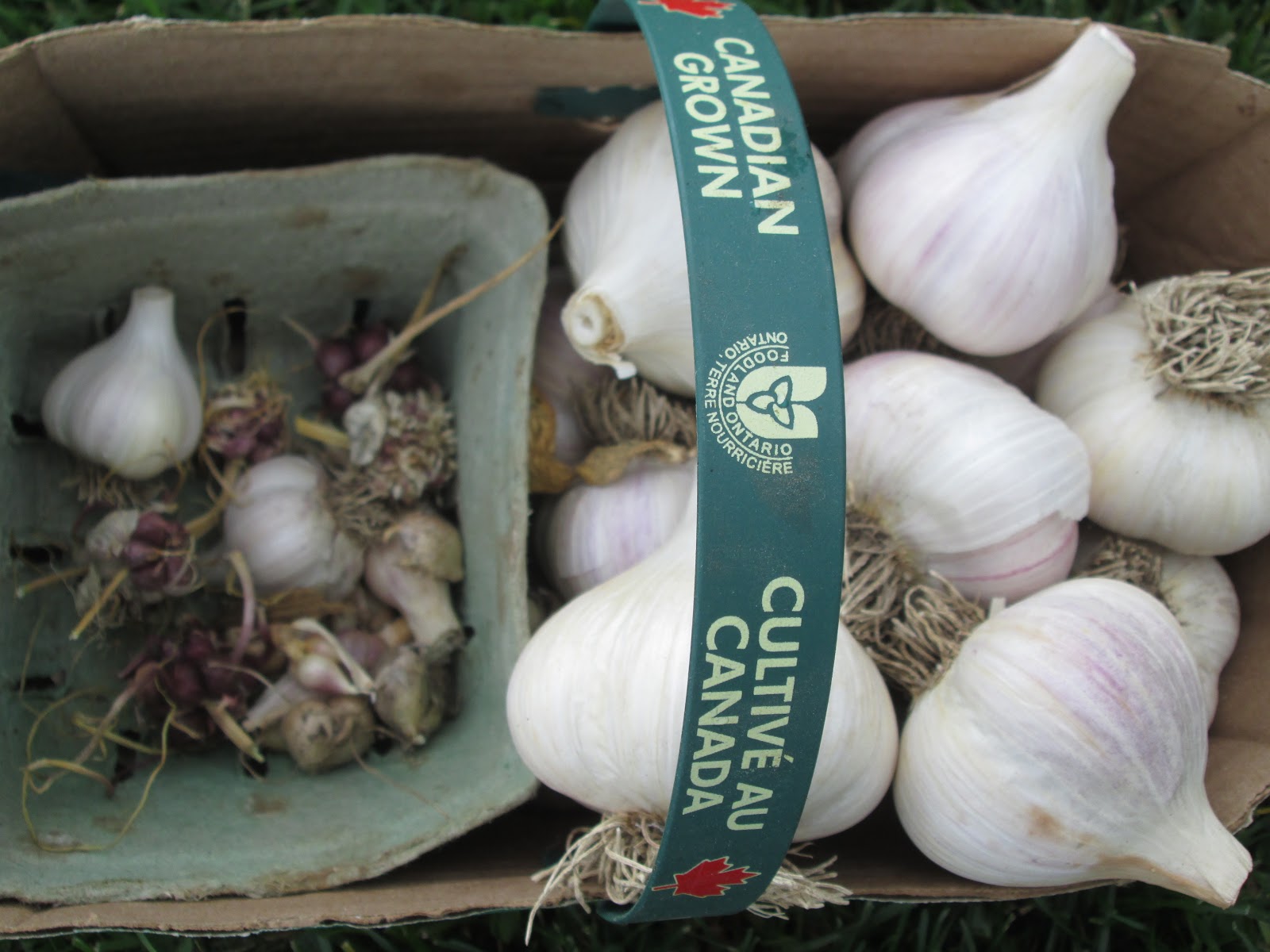 |
| Seed garlic, the new stock on the left and the mature heads on the right |
After the freshly harvested garlic has been hung to air dry for a couple of weeks and you're ready to store it for the winter, you choose your best heads to use as seed. It is also a good idea to plant some bulbils if you have let some of the garlic flower and go to seed. These little bulbils become new seed for the future - a way of ensuring your stock stays healthy and is less likely to become prey to ongoing pest and disease problems.
 |
| A clove ready to be planted, flat end down |
 |
| The new garlic bed clothed in its blanket of fall leaves |
Sunday, 30 September 2012
Soil Fertility - Part Three - Green Manure and Cover Crops
Writing this from Arizona, where there is such incredible soil erosion, both generally in the landscape and also in the dust clouds over the denuded fields shorn of one crop and awaiting another, seems to give a sense of timeliness to the discussion of keeping land "clothed".
Reasons for planting cover crops include reducing soil erosion, increasing soil fertility and maintaining moisture in the soil. Bare soil is open to erosion both from wind and heavy rain.
Bare soil tends to develop a crust which prevents moisture from soaking in, especially in a hard rainfall. This happens in the "washes" of the the American Southwest where there are dangerous flash floods annually. This suspension bridge (below) in Boyce Thompson Arboretum in Arizona seems completely unnecessary. But in the monsoon season the creek bed underneath will instantly become a wild and rushing torrent.
Here in Toronto in the case of Keating Channel where the Don River empties into Lake Ontario, the banks of the river have been replaced with concrete and metal walls so the water doesn't have a chance to leach slowly into what was originally a naturally occurring flood plain.
When cover crops are planted to increase soil fertility they are called green manure. These cover crops can be selected to contribute specific nutrients to the soil. Legumes, for example, are planted because they can fix nitrogen from the air in the soil. But any cover crop will add organic matter when turned into the soil. The continued process of adding biomass will slowly improve soil structure, water retension and microbial life.
I was able to get some organic rye seeds from my farmer friend, Charlie, to plant in the new beds in the field after I had dug the potatoes. Next spring I will spread compost over the rye and then turn it into the soil. If the soil is poor then cover crops can actually deplete nutrients as the decompose. So spreading manure or compost before turning in the cover crop should ensure that it is actually contributing (and not removing) fertility.
I had originally thought that the path bisecting the beds on a north/south axis could just be earth, which would compact over time. However, as the summer progressed and we experienced prolonged drought punctuated by infrequent torrential downpours, I realized that with its gentle downward grade the path was going to become a major source of soil erosion. So I have sown Dutch white clover. It will not be turned into the soil but will need to be periodically mown. I'll either leave the clippings in place or, if there are enough, rake them onto the adjacent beds.
Reasons for planting cover crops include reducing soil erosion, increasing soil fertility and maintaining moisture in the soil. Bare soil is open to erosion both from wind and heavy rain.
Bare soil tends to develop a crust which prevents moisture from soaking in, especially in a hard rainfall. This happens in the "washes" of the the American Southwest where there are dangerous flash floods annually. This suspension bridge (below) in Boyce Thompson Arboretum in Arizona seems completely unnecessary. But in the monsoon season the creek bed underneath will instantly become a wild and rushing torrent.
 |
| Suspension bridge in Boyce Thompson Arboretum, Arizona |
Here in Toronto in the case of Keating Channel where the Don River empties into Lake Ontario, the banks of the river have been replaced with concrete and metal walls so the water doesn't have a chance to leach slowly into what was originally a naturally occurring flood plain.
 |
| Mouth of the Don River with concrete walls |
When cover crops are planted to increase soil fertility they are called green manure. These cover crops can be selected to contribute specific nutrients to the soil. Legumes, for example, are planted because they can fix nitrogen from the air in the soil. But any cover crop will add organic matter when turned into the soil. The continued process of adding biomass will slowly improve soil structure, water retension and microbial life.
I was able to get some organic rye seeds from my farmer friend, Charlie, to plant in the new beds in the field after I had dug the potatoes. Next spring I will spread compost over the rye and then turn it into the soil. If the soil is poor then cover crops can actually deplete nutrients as the decompose. So spreading manure or compost before turning in the cover crop should ensure that it is actually contributing (and not removing) fertility.
 |
| Rye on the left and Dutch white clover on the path |
 |
| Rye three weeks after sowing |
 |
| Clover germinating on the path |
Tuesday, 25 September 2012
Soil Fertility Part Two - Fall leaves
Officially fall is here and, perhaps a little late, the leaves are starting to turn colour and soon streets and hillsides will be a riot of oranges, reds and yellows. But that is not the only fall ritual that is returning - there is also the bagging of fall leaves for collection in the city or to be deposited at the dump in the country.
Each day my headstrong dog, Scylla, takes me out for a walk. Last year, a little later in the season when the deadline for leaf collection was fast approaching, virtually every house we walked by was lined with brown paper bags of leaves. The scramble was on to get rid of these blights on the landscape. But which was the blight - each home's two to twenty kraft paper bags or the leaves within?
This practice of getting rid of autumn leaves seems to be a powerful symbol of how completely we have distanced ourselves from nature, and common sense. When hardwood trees shed their leaves in the fall that is as much a part of the cycle of growth and regeneration as the first snowdrop pushing through the snow in March and these same trees leafing out in the spring.
Each bag of leaves sitting on the sidewalk is a source of free fertilizer for that household. Yet we use finite resources to produce garden waste bags, we pay city workers to remove the leaves and then use precious fossil fuels to transport them to a composting facility. Next spring each household is allowed to drive to a transfer station and take one cubic mere of finished compost back home to their garden. Since gardens need more nourishment than the the next trip is to the garden centre to purchase commercial fertilizer, which is sold in heavy plastic bags. So we pay to have our own free fertilizer removed and the later spend more money to buy an inferior commercial version of what we could have had for free.
Removing leaves from streets can be justified. Wet leaves contribute to slick driving conditions and add to the burden of snow removal in the winter. But household leaves are a different matter. They are a free and easy source of much needed organic matter and nutrients that nature intends to be returned to the soil each year. The cycle shade trees go through each year from leafing out in the spring to providing us relief from the sun in the summer to losing their leaves in the fall is a perfect natural system. As long as we don't interfere.
Fall leaves are an incomparable source of nutrients. Being deep rooted, trees are able to bring up minerals not accessible to more shallow rooted shrubs, perennials and annuals. These minerals then end up in the leaves which fall to the ground as the weather cools. Whether you're thrifty and hate spending money unnecessarily, want a pristine uncluttered lawn or just love your garden and want it to be as beautiful as possible, fall leaves are to be hoarded, coveted, cherished.
Depending on the need or energy of the homeowner, leaves can be used to produce leaf compost, mulch or leaf mold. Each of these requires a slightly different process and vary in their nutritional value and garden usage.
For compost, leaves provide a much needed source of carbon. Most composting tends to have ready supplies of nitrogen from grass clippings and most kitchen waste. Carbon is necessary for the heating up and then breaking down of raw materials. Shredding leaves and turning the compost pile will hasten decomposition but are not necessary. There are approximately twice as many minerals in leaf compost as in manure. Leaf compost is an important source of organic material and will miraculously remediate virtually any soil type - clay to sand.
Leaf mulch is just shredded leaves. It can be used immediately to protect shrubs and tender perennials from the extremes of winter cold and summer drought. To prevent matting a certain amount of shredding is worth the minimal effort.
While leaf mold is not as rich a fertilizer as leaf compost it does have the ability to retain water three to five times its weight. Once again shredding the leaves is beneficial. They are left in a pile and as long as there is adequate moisture they will turn to a rich crumb in a couple of years.
Whether it be leaf compost, much or mold, all are easy to make in a forgotten corner of the yard. Then the next spring or fall each household has a free, accessible source of fertilizer. No more driving to garden centres and lugging home heavy plastic bags of triple mix, fertilizer or peat moss, which is a finite resource and as such should be avoided.
Then there is the issue of draft paper bags. No they haven't been bleached but they have been manufactured using vast quantities of water at sustained high temperatures. Kraft paper is an excellent product and has its place. Garden bags just aren't one of them.
And what about gas powered leaf blowers? Think of the sheer absurdity of a landscape company which claims to be taking care of your lawn and garden and, in the process, consumes fossil fuels operating a machine at obnoxious noise levels whose purpose is to blow away all your property's natural and free fertilizer maintenance in the name of maintenance. And you pay them to do it!
Last October my daughter, Alex, returned to Ontario for the month. While here she visited my parents in Burlington. One day was beautiful and sunny and Alex and her 88 year old grandmother spent the day spreading the previous year's leaf mold around the garden and raking the leaves into the chicken wire enclosure to await the transformation into next year's garden "gold". Both of them told me how much they enjoyed the day: each other's quiet companionship, the beautiful weather, puttering around in the garden and the anticipation of repeating the whole experience next year. It sounded like the perfect day.
Quitte a few years ago the City of Toronto stopped collecting grass clippings - suggesting that they be left on lawns instead to act as slow acting fertilizer. How enlightened. I can only hope that one day both cities and town waste disposals will come to the same conclusion about leaf collection.
 |
| One maple in the Don Valley changing colour |
Each day my headstrong dog, Scylla, takes me out for a walk. Last year, a little later in the season when the deadline for leaf collection was fast approaching, virtually every house we walked by was lined with brown paper bags of leaves. The scramble was on to get rid of these blights on the landscape. But which was the blight - each home's two to twenty kraft paper bags or the leaves within?
 |
| One household's leaf bags last year |
This practice of getting rid of autumn leaves seems to be a powerful symbol of how completely we have distanced ourselves from nature, and common sense. When hardwood trees shed their leaves in the fall that is as much a part of the cycle of growth and regeneration as the first snowdrop pushing through the snow in March and these same trees leafing out in the spring.
Each bag of leaves sitting on the sidewalk is a source of free fertilizer for that household. Yet we use finite resources to produce garden waste bags, we pay city workers to remove the leaves and then use precious fossil fuels to transport them to a composting facility. Next spring each household is allowed to drive to a transfer station and take one cubic mere of finished compost back home to their garden. Since gardens need more nourishment than the the next trip is to the garden centre to purchase commercial fertilizer, which is sold in heavy plastic bags. So we pay to have our own free fertilizer removed and the later spend more money to buy an inferior commercial version of what we could have had for free.
Removing leaves from streets can be justified. Wet leaves contribute to slick driving conditions and add to the burden of snow removal in the winter. But household leaves are a different matter. They are a free and easy source of much needed organic matter and nutrients that nature intends to be returned to the soil each year. The cycle shade trees go through each year from leafing out in the spring to providing us relief from the sun in the summer to losing their leaves in the fall is a perfect natural system. As long as we don't interfere.
Fall leaves are an incomparable source of nutrients. Being deep rooted, trees are able to bring up minerals not accessible to more shallow rooted shrubs, perennials and annuals. These minerals then end up in the leaves which fall to the ground as the weather cools. Whether you're thrifty and hate spending money unnecessarily, want a pristine uncluttered lawn or just love your garden and want it to be as beautiful as possible, fall leaves are to be hoarded, coveted, cherished.
 |
| Just a few trees starting to change colour |
Depending on the need or energy of the homeowner, leaves can be used to produce leaf compost, mulch or leaf mold. Each of these requires a slightly different process and vary in their nutritional value and garden usage.
For compost, leaves provide a much needed source of carbon. Most composting tends to have ready supplies of nitrogen from grass clippings and most kitchen waste. Carbon is necessary for the heating up and then breaking down of raw materials. Shredding leaves and turning the compost pile will hasten decomposition but are not necessary. There are approximately twice as many minerals in leaf compost as in manure. Leaf compost is an important source of organic material and will miraculously remediate virtually any soil type - clay to sand.
Leaf mulch is just shredded leaves. It can be used immediately to protect shrubs and tender perennials from the extremes of winter cold and summer drought. To prevent matting a certain amount of shredding is worth the minimal effort.
While leaf mold is not as rich a fertilizer as leaf compost it does have the ability to retain water three to five times its weight. Once again shredding the leaves is beneficial. They are left in a pile and as long as there is adequate moisture they will turn to a rich crumb in a couple of years.
Whether it be leaf compost, much or mold, all are easy to make in a forgotten corner of the yard. Then the next spring or fall each household has a free, accessible source of fertilizer. No more driving to garden centres and lugging home heavy plastic bags of triple mix, fertilizer or peat moss, which is a finite resource and as such should be avoided.
Then there is the issue of draft paper bags. No they haven't been bleached but they have been manufactured using vast quantities of water at sustained high temperatures. Kraft paper is an excellent product and has its place. Garden bags just aren't one of them.
And what about gas powered leaf blowers? Think of the sheer absurdity of a landscape company which claims to be taking care of your lawn and garden and, in the process, consumes fossil fuels operating a machine at obnoxious noise levels whose purpose is to blow away all your property's natural and free fertilizer maintenance in the name of maintenance. And you pay them to do it!
Last October my daughter, Alex, returned to Ontario for the month. While here she visited my parents in Burlington. One day was beautiful and sunny and Alex and her 88 year old grandmother spent the day spreading the previous year's leaf mold around the garden and raking the leaves into the chicken wire enclosure to await the transformation into next year's garden "gold". Both of them told me how much they enjoyed the day: each other's quiet companionship, the beautiful weather, puttering around in the garden and the anticipation of repeating the whole experience next year. It sounded like the perfect day.
 |
| Sumach, often the first to change colour, in full fall glory |
Quitte a few years ago the City of Toronto stopped collecting grass clippings - suggesting that they be left on lawns instead to act as slow acting fertilizer. How enlightened. I can only hope that one day both cities and town waste disposals will come to the same conclusion about leaf collection.
Monday, 17 September 2012
I get by with a little help from my friends
The time has come to pay tribute to the friends and family who helped out in the garden this year. While it is true that "many hands make light work" it is also just a nice place to have lots of people around; a big farmhouse kitchen to eat meals in, a pool to cool off in and the beautiful paths through the woods to the corner of the field that Christopher so carefully maintains all season long.
Avo
Avo has helped out on projects for over twenty years, from building the deck and the stairs (twice now) with Christopher, to working with Alex to prune trees in our woods. He has provided the chainsaw again and again - most recently to deal with the huge limb that broke off our old apple tree, one of the few trees that we inherited when we bought the property more than twenty years ago.
 |
| Avo ready to start replacing the back stairs |
 |
| Alex and Avo discuss strategy for removing this pine tree |
Alex
 |
| A sunny day in the spring as Alex prepares the ground for the hotboxes |
Diane
Diane is a more recent recruit. This spring she mulched our struggling young trees with cardboard and clippings from the pruning Avo and Alex were doing on the more established trees. And I think, despite the drought of this summer, that the young trees Diane mulched have really benefitted from the reduced competition at their base. Then later in the spring we worked together on planting the first potatoes.
 |
| Diane digs trenches for the French Fingerlings |

Benjamin
Benjamin and I had never met but we had a warm relationship through email since he has become a member of the CSA this spring. So I was thrilled when he volunteered to come up and help out. While he weeded the raspberries and dug Yukon Gold potatoes I was finally able to weed the leek bed. Later he helped save lettuce and kale seed. Only later that day did I learn that he took time to make the visit ten days before his wedding!
 |
| Having finished weeding the new raspberries Benjamin moves on to digging Yukon Gold potatoes |
Jill
Jill came for just over 18 hours but even so she stayed long enough to dig some of the Banana Fingerlings.
 |
| Jill puts her efforts into digging Banana fingerlings |
Charlie has helped me in so many ways in the past couple of years. He is really the only other person I know in my area with whom I can swap tales of woe and triumph and compare how the season is going in general. As a farmer with a diversified operation including fields of grain and livestock he has also been able to help with everything from tilling my new bed in the field to giving me some of his own organic rye to plant as a cover crop this fall.
 |
| Charlie tills a new bed in the field |
Thea and Scylla
And last but certainly not least, my four footed constant companions, Thea and Scylla. They keep me company, agree with everything I say to them all day long and remind me that by the time the shadows are long, the time has come for some R and R. Which is a glass of wine or beer for me and playing "catch" for them - the squeaky ball for Thea and the cuz or "squirrel" for Scylla.
 |
| Scylla covetously guards her cuz while Thea keeps a watchful eye as I add manure to this about-to-be seeded bed |
 |
| And now four months later all that has really changed is which bed we're in |
Subscribe to:
Posts (Atom)